SSAS Exit Fees Explained: What You Pay When Leaving a Mortgage
Written by Matt Lenzie
Former Banker & Corporate Finance Partner
SSAS Exit Fees and Early Repayment Charges: What You Need to Know
When it comes to SSAS mortgage costs, most attention focuses on the upfront arrangement fee and the ongoing interest rate. But exit costs — the fees charged when you repay the mortgage — can be equally significant, particularly if circumstances change and you need to repay early or switch lender before the end of the term.
This guide explains the two main types of exit cost for SSAS mortgages — exit fees and early repayment charges — how they are calculated, when they apply, and how to plan your SSAS financing to minimise unnecessary exit costs.
What Is an Exit Fee?
An exit fee (sometimes called a redemption fee) is a charge levied by some lenders when a mortgage is repaid, regardless of whether the repayment is early or at the end of the agreed term. It is distinct from an early repayment charge — it applies even at maturity.
Not all SSAS mortgage lenders charge exit fees. Where they do, they are typically expressed as a percentage of the outstanding loan at the time of repayment:
- Typical range: 0.5% to 2% of the outstanding loan
- On a £300,000 loan at 1%, this represents £3,000
Exit fees are most common in the specialist and challenger lender segment of the SSAS market. Mainstream commercial lenders and high street banks are less likely to charge exit fees, though they may compensate through slightly higher interest rates.
What Is an Early Repayment Charge (ERC)?
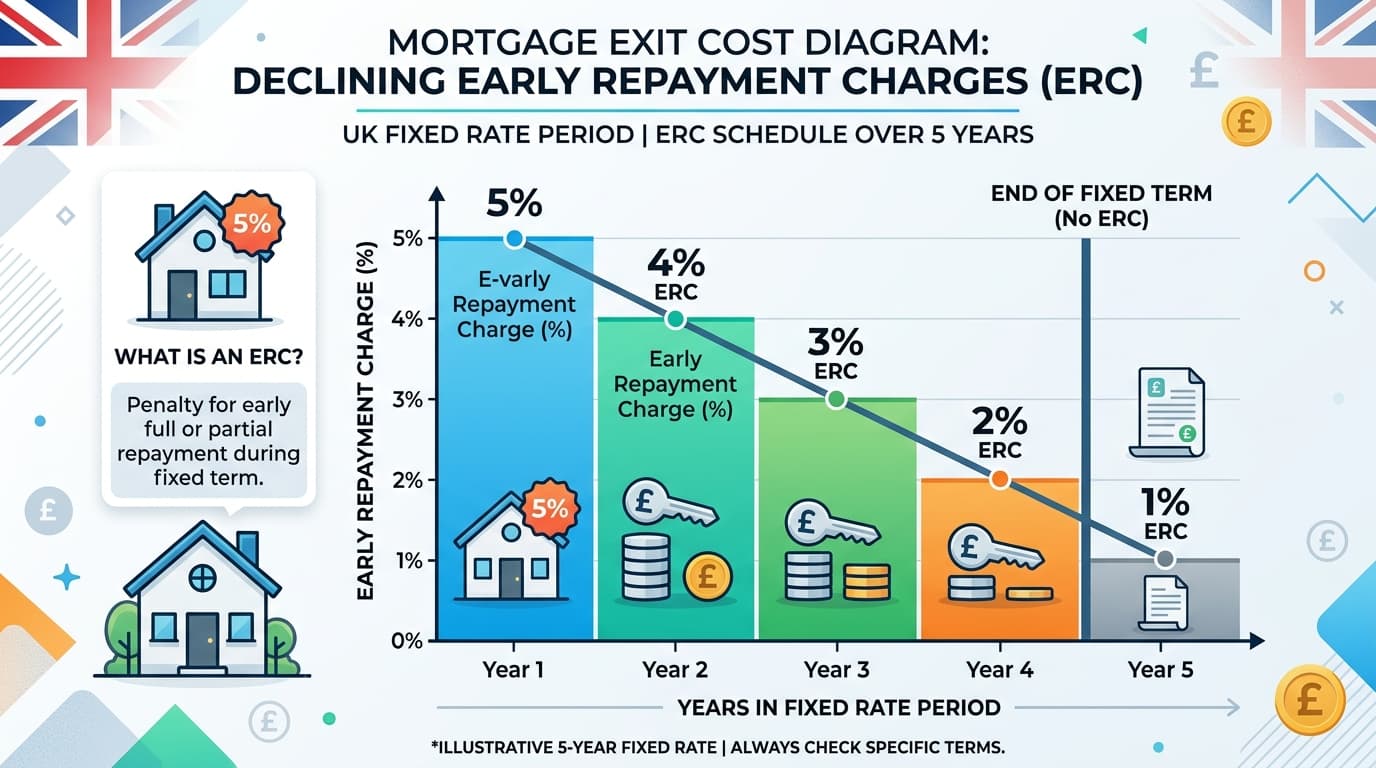
An early repayment charge applies when a mortgage is repaid before the end of the agreed term or the end of a fixed rate period. ERCs are most common on fixed rate products — they compensate the lender for the interest income it loses when a fixed rate loan is repaid early.
ERCs are typically structured as a declining percentage of the outstanding loan, reducing over the fixed period:
- Year 1: 3-5% of outstanding balance
- Year 2: 2-4%
- Year 3: 1-3%
- Year 4 (if applicable): 1-2%
- After fixed period: nil
On a £300,000 loan with a 3% ERC in Year 1, the charge would be £9,000. This is a significant cost that must be factored into any decision to repay early or refinance.
"Exit fees and ERCs are often the hidden cost that clients overlook when comparing products. A mortgage that looks cheaper on rate may carry significant exit costs that make it expensive overall if your circumstances change. Always check the exit terms before committing." — Matt Lenzie, Former Banker & Corporate Finance Partner
When Do Exit Costs Matter Most for SSAS?
Exit costs are particularly relevant for SSAS schemes in the following situations:
Property Sale
If the SSAS sells the mortgaged property — perhaps to the sponsoring employer, to a third party, or as part of a wider scheme wind-up — the mortgage must be repaid. If the sale occurs during an ERC period or on a product with an exit fee, these costs will reduce the net proceeds available to the scheme.
Refinancing
Refinancing to a better rate, a different lender, or a different loan structure involves repaying the existing mortgage. If ERCs or exit fees apply, these must be weighed against the benefit of the new product. It may not be economically rational to refinance until the ERC period has expired.
Employer Insolvency
If the sponsoring employer ceases trading, the SSAS may need to find a new tenant or sell the property. If the mortgage has ERCs, the scheme's ability to act flexibly in response to this event is constrained by the cost of exit.
Scheme Wind-Up
When members reach retirement and the SSAS begins to wind down, the property will typically need to be sold or transferred. Exit costs need to be factored into the wind-up timeline and planning.
How to Minimise Exit Costs
Choose Variable Rate Products for Flexibility
Variable rate SSAS mortgages typically have lower or no ERCs compared to fixed rate products. If flexibility is important — because you expect to sell, refinance, or repay within the next few years — a variable rate product may be a better choice even if the initial rate is slightly higher. See our SSAS fixed vs variable rates guide for the full comparison.
Align Fixed Periods with Your Property Horizon
If you are confident you will hold the property for five or more years, a five-year fixed rate product aligns the ERC period with your holding period — meaning ERCs should not apply at exit. Mismatching your fixed period and your expected holding period creates avoidable ERC exposure.
Negotiate Exit Fee Terms
Exit fees are sometimes negotiable, particularly for larger loans or for borrowers with strong relationships with the lender. Ask specifically about exit fee terms when comparing products — a lender that waives or reduces the exit fee may offer better total cost than a headline rate comparison suggests.
Build Exit Cost Awareness into Your Financial Planning
Model the exit cost alongside the entry costs and ongoing interest rate in every SSAS mortgage decision. Our SSAS mortgage calculator allows you to input exit fees and ERCs alongside rate and term to calculate the true total cost of each product option.
Questions to Ask Before Committing
- Is there an exit fee? If so, what percentage and on what balance?
- Are there early repayment charges? What is the schedule?
- Do ERCs apply if I sell the property and repay from the sale proceeds?
- Are ERCs waivable in exceptional circumstances (employer insolvency, death of member)?
- Do ERCs reduce if I make partial capital repayments during the fixed period?
Key Takeaways
- Exit fees are charged by some lenders on all repayments, including at maturity — typically 0.5-2% of the outstanding balance
- ERCs apply when fixed rate mortgages are repaid early — typically 1-5% of the outstanding balance, declining over the fixed period
- Variable rate mortgages generally have lower exit costs, offering more flexibility
- Model exit costs as part of total cost over your planned holding period before committing
- Align fixed rate periods with your expected property holding period to minimise ERC exposure
Get Exit Cost Clarity Before You Commit
Our team models the full cost of SSAS mortgage products — including exit costs — before recommending any product to our clients.
Get in touch for a complete cost analysis, or read our guide to SSAS arrangement fees for the other side of the cost picture.
About the Author
Matt Lenzie
Former Banker & Corporate Finance Partner
Matt Lenzie is a former banker and corporate finance partner with extensive experience in pension-backed property transactions. He founded SSAS Property Finance to help company directors and trustees navigate the complexities of commercial property acquisition through Small Self-Administered Schemes.