SSAS Interest-Only Mortgages: How They Work for Pension Schemes
Written by Matt Lenzie
Former Banker & Corporate Finance Partner
SSAS Interest-Only Mortgages: The Standard Structure
The large majority of SSAS commercial property mortgages are structured on an interest-only basis. This means that during the mortgage term, the SSAS pays only the interest on the outstanding loan — the capital balance remains constant and must be repaid at the end of the term or through a separate repayment vehicle. Understanding why this is the standard approach, and the implications for your scheme's finances, is essential for sound SSAS mortgage planning.
Interest-Only vs Repayment for SSAS
With a repayment mortgage, each monthly payment consists of interest plus a portion of the capital balance. Over the mortgage term, the capital is paid down to zero. Monthly payments are higher than for an equivalent interest-only loan, but the scheme has no outstanding debt at the end of the term.
With an interest-only mortgage, monthly payments cover only the interest. The capital balance is unchanged throughout the term and must be repaid at maturity — either by refinancing, selling the property, or using other scheme assets.
For SSAS commercial property, interest-only is the norm because:
- Commercial property is typically held as a long-term investment, not amortised over the mortgage term
- The lower monthly payments maximise the scheme's cash flow during the investment period
- The capital appreciation of the property (if any) addresses the capital repayment at exit
- The rental income from the property needs to service the debt — interest-only payments are more easily covered by commercial rents
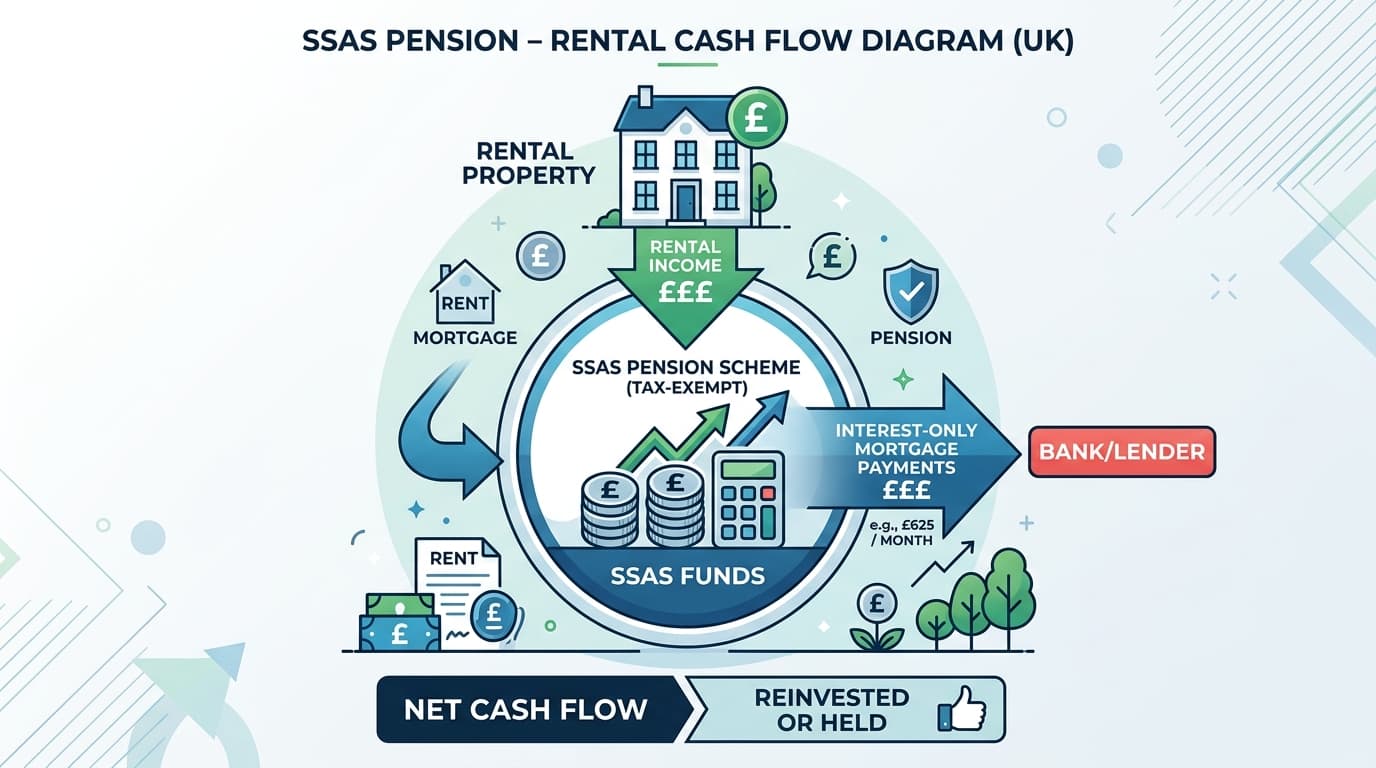
How SSAS Interest-Only Cash Flows Work
Consider a SSAS purchasing a commercial property for £500,000 with a 50% LTV interest-only mortgage of £250,000 at 7% per annum:
- Annual interest payment: £17,500 (£250,000 x 7%)
- Monthly interest payment: £1,458
- Market rent on the property: assume £25,000 per annum (5% gross yield)
- Net rental income after interest: £7,500 per annum
In this example, the rental income comfortably services the interest, with surplus income of £7,500 per annum building within the SSAS. This surplus can be reinvested or held as cash within the scheme.
On a repayment basis over twenty years, the monthly payment would be approximately £1,940 — covering both interest and capital repayment. Annual payments would be £23,280, leaving only £1,720 of surplus from £25,000 of rent. The interest-only structure preserves more of the rental income as scheme cash flow.
"For SSAS property investment, interest-only is almost always the right structure. The pension fund is building wealth through rental income and property appreciation — not through paying down a mortgage. The repayment of capital is addressed through the eventual property sale or refinance when the time is right." — Matt Lenzie, Former Banker & Corporate Finance Partner
The Repayment Strategy: Planning for Maturity
The main risk with interest-only lending is the capital repayment at the end of the term. If the property has not appreciated sufficiently, or if the scheme does not have other assets to draw on, the scheme may face difficulty meeting the repayment obligation.
For SSAS schemes, the repayment strategy typically involves one or more of the following:
Property Sale
The most common exit: the SSAS sells the property at the end of the mortgage term, uses the proceeds to repay the loan, and retains any surplus as scheme assets. For this to work, the property value must have at least maintained its value relative to the loan amount.
Refinancing
At the end of the mortgage term, the scheme refinances onto a new interest-only mortgage — effectively rolling the loan forward for another term. This is viable as long as the property remains mortgageable and the scheme's financial position supports continued borrowing.
Loan Repayment from Other Scheme Assets
If the SSAS has accumulated other assets during the mortgage term — from pension contributions, investment growth, or other income — it may be able to repay the mortgage from these assets without selling the property.
Tenant Purchase
In a connected party scenario, the sponsoring employer may purchase the property from the SSAS as part of exit planning — allowing the scheme to repay the mortgage and release the capital value. This is subject to the same arm's length requirements as any other connected party transaction.
Lender Requirements for SSAS Interest-Only
SSAS lenders typically require evidence of the repayment strategy before granting an interest-only mortgage. The strength of the required evidence varies by lender but typically includes:
- A clear statement of the intended repayment route (sale, refinance, or repayment from assets)
- Evidence that the scheme has the capacity to absorb the capital repayment if the property value falls
- For longer terms, projected scheme financial statements demonstrating the ongoing viability of the arrangement
Key Takeaways
- Interest-only is the standard structure for SSAS commercial property mortgages
- Lower monthly payments maximise scheme cash flow during the investment period
- The capital balance must be repaid at maturity — through property sale, refinancing, or use of other scheme assets
- A clear repayment strategy is required by lenders and is essential for sound pension planning
- Property appreciation over the holding period is the most common source of capital repayment
Structure Your SSAS Mortgage the Right Way
Our team can help you model the interest-only vs repayment trade-off for your specific SSAS transaction and build a repayment strategy that protects the scheme over the long term.
Contact us to discuss your SSAS mortgage requirements, or use our SSAS mortgage calculator to model the cash flows.
About the Author
Matt Lenzie
Former Banker & Corporate Finance Partner
Matt Lenzie is a former banker and corporate finance partner with extensive experience in pension-backed property transactions. He founded SSAS Property Finance to help company directors and trustees navigate the complexities of commercial property acquisition through Small Self-Administered Schemes.