Bridging to Term Loan: Using Bridging Finance in an SSAS
Written by Matt Lenzie
Former Banker & Corporate Finance Partner
Why SSAS Schemes Use Bridging Finance
Standard SSAS mortgages typically take 3-5 months from initial enquiry to completion. In competitive property markets, this timeline can mean missing opportunities that require a faster exchange or completion. Bridging finance — short-term secured lending that can complete in days or weeks — provides a solution.
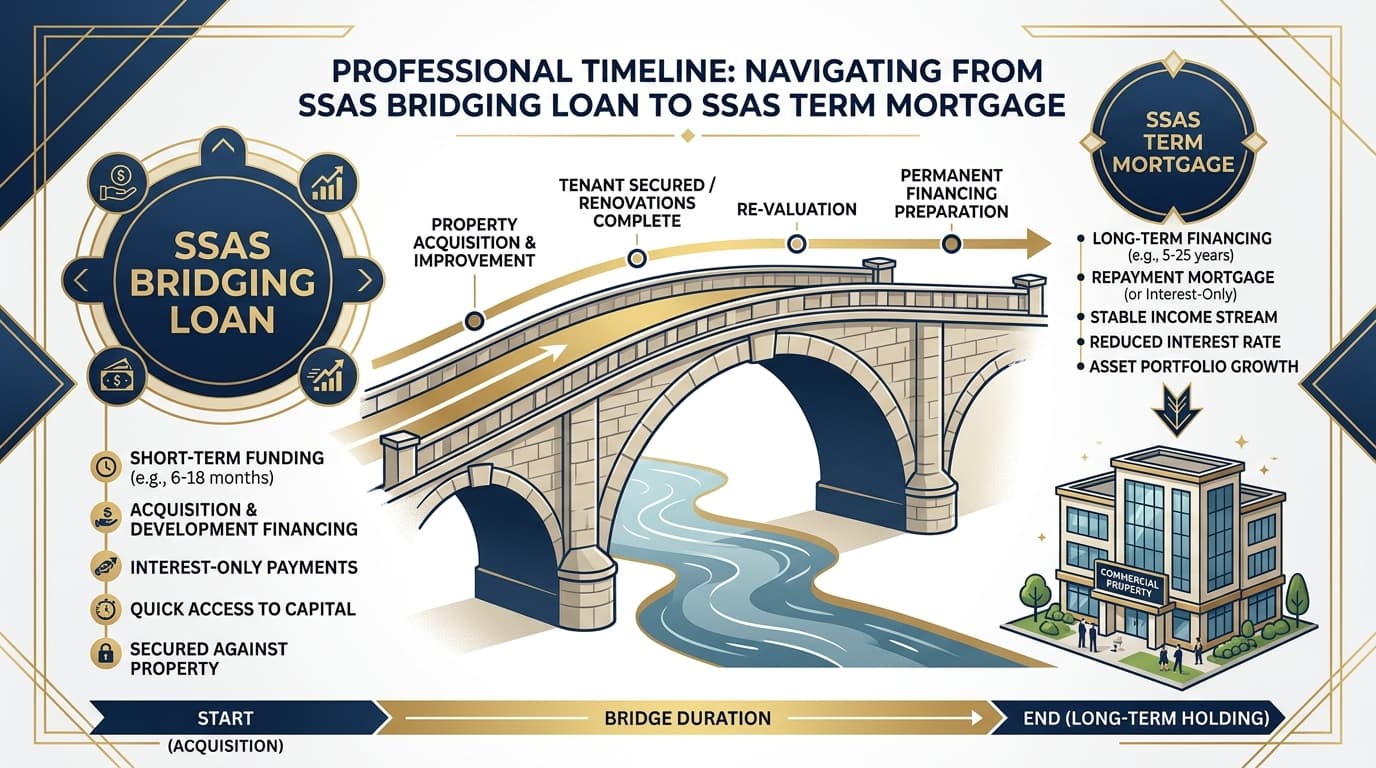
The bridging-to-term-loan strategy involves:
- Using a short-term bridging loan to acquire the property quickly
- Simultaneously or subsequently arranging a standard SSAS term mortgage
- Using the term mortgage proceeds to repay the bridging loan at the end of the bridge term
In our experience, this strategy is increasingly used by SSAS trustees who've found their ideal property but can't complete a full mortgage application in time to secure the deal.
When Bridging Finance Makes Sense for SSAS
Bridging finance is most appropriate in SSAS property transactions when:
- Auction purchases: Properties bought at auction must typically complete within 28 days — impossible with a standard SSAS mortgage
- Motivated seller situations: Where a vendor needs a fast sale and a slower buyer would lose out
- Uninhabitable or non-standard properties: Some commercial properties with significant works required won't qualify for standard term finance until refurbished
- Development completions: Where an SSAS is buying a newly completed commercial unit and needs to move quickly
- Chain-break situations: Where the SSAS needs to complete on a new property before a sale of an existing scheme asset completes
How SSAS Bridging Loans Work
SSAS bridging loans are secured against the property being acquired (and sometimes additional collateral). Key features:
- Loan-to-value: Typically up to 70-75% of the property's current market value (or gross development value for works-heavy properties)
- Term: Usually 3-18 months, though most SSAS bridges complete a term refinancing within 3-6 months
- Interest: Typically charged monthly at 0.6-1.2% per month (7-15% per annum), depending on LTV, property type, and lender risk appetite
- Rolled or retained interest: Interest can often be rolled up into the loan and repaid at exit, preserving scheme cash flow during the bridge period
- Arrangement fee: Typically 1-2% of the loan amount
Matt Lenzie notes: "The monthly interest rate on bridging can look alarming at first glance. But when you're comparing it against losing a property deal that could generate 20 years of tax-free rental income inside a pension scheme, the bridging cost is often a trivial consideration."
The HMRC Cap and Bridging Finance
A critical point: bridging loans count towards the SSAS's total borrowing for the purposes of the HMRC 50% cap. This means your scheme must have sufficient HMRC borrowing headroom to accommodate the bridging loan — even if the bridge is intended to be short-term.
Calculate your headroom carefully before drawing any bridge. If the bridging loan combined with existing scheme borrowing would breach 50% of net scheme assets, the bridge cannot proceed as planned.
See our guide to the SSAS 50% LTV cap for a detailed explanation of how to calculate your headroom.
Selecting the Right Bridging Lender
Not all bridging lenders understand SSAS structures. Key requirements for selecting a bridging lender for an SSAS transaction:
- Proven experience lending to pension schemes (SSAS or SIPP)
- Willingness to lend to a pension trust as borrower (not a personal or corporate borrower)
- Understanding of the HMRC regulatory environment
- Realistic exit criteria that work with the SSAS term mortgage timeline
Our lender panel includes specialist bridging providers experienced in SSAS lending.
Planning the Exit: From Bridge to Term
The exit from a bridging loan is the most critical element of the strategy. Before drawdown, you should have a credible exit route in place:
Option 1: Term Mortgage Refinance
The most common exit. A specialist SSAS mortgage lender agrees to provide a term mortgage secured against the property. Timing is critical — the term mortgage must complete before the bridge term expires (or the bridge must be extended, at additional cost).
We recommend having at minimum a Decision in Principle from a term lender before drawing the bridge. Ideally, have a formal mortgage offer in place.
Option 2: Property Sale
Less common for SSAS, but sometimes used where the scheme acquires a property, adds value (e.g., through planning or lease improvements), and then sells it. The sale proceeds repay the bridge.
Option 3: Extension of the Bridge
Most bridging lenders will extend the term if the exit is delayed, but this carries additional cost and risk. Never rely on extension as a primary exit strategy.
Cost Comparison: Bridging + Term vs. Direct Term Mortgage
The bridging-to-term strategy adds costs versus going directly to a term mortgage. These typically include:
- Bridging interest for the bridge period (e.g., 6 months at 0.8%/month on £200,000 = £9,600)
- Bridging arrangement fee (e.g., 1.5% = £3,000)
- Additional legal costs for the bridge transaction
- Exit fee from bridging lender (some charge 0.5-1%)
These costs must be weighed against the value of acquiring the property at a particular price versus a competitor who completes more slowly. In many cases, the additional cost is well justified.
Key Takeaways
- SSAS bridging finance allows pension schemes to compete in fast-moving property markets
- The exit from the bridge must be planned before drawdown — ideally with a term lender's DIP in place
- Bridging loans count towards the HMRC 50% borrowing cap
- Monthly bridging interest can look expensive but must be weighed against the opportunity cost of missing a property
- Select a bridging lender with proven SSAS experience
Explore SSAS Bridging Finance
If you've found an opportunity that requires faster completion than a standard SSAS mortgage allows, our team can help you structure a bridging-to-term solution.
Contact us today to discuss your specific situation, or explore our SSAS property finance page for a full overview of financing options.
About the Author
Matt Lenzie
Former Banker & Corporate Finance Partner
Matt Lenzie is a former banker and corporate finance partner with extensive experience in pension-backed property transactions. He founded SSAS Property Finance to help company directors and trustees navigate the complexities of commercial property acquisition through Small Self-Administered Schemes.