SSAS Borrowing Power Calculation: A Complete Guide
Written by Matt Lenzie
Former Banker & Corporate Finance Partner
Two Calculations You Need to Master
When SSAS trustees ask about their borrowing power, there are actually two distinct calculations involved. Getting both right is essential for structuring property transactions that are compliant and commercially viable.
- The HMRC test: Maximum borrowing = 50% of net scheme asset value. This is the regulatory ceiling and cannot be exceeded.
- The lender test: Maximum advance = lender's LTV percentage × property value, subject to income coverage requirements. This is what the lender will actually offer within the regulatory ceiling.
In our experience, many SSAS trustees focus only on one of these calculations. The HMRC test tells you the outer limit; the lender test tells you what you can actually get. The effective maximum is the lower of the two.
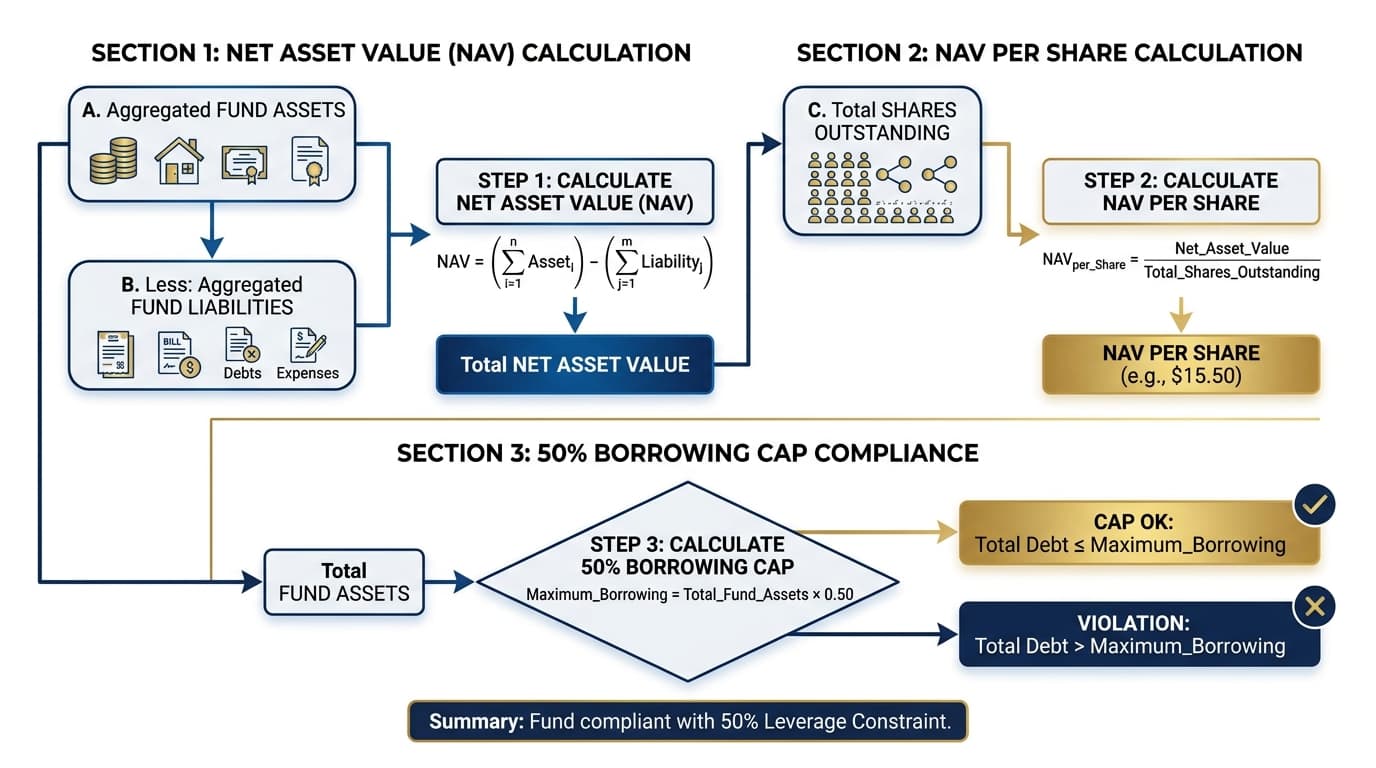
Step 1: Calculate Net Scheme Asset Value
Start by listing all scheme assets at current market value:
- Commercial property held by the scheme (at current market value, not purchase price)
- Cash held in scheme bank accounts
- Stocks, bonds, and other quoted investments (at market value)
- Unquoted shares (at professional valuation)
- Loanback receivables (the amount owed to the scheme by the sponsoring employer)
- Any other assets
Then deduct all scheme liabilities:
- Outstanding mortgage balances
- Any other borrowing by the scheme
- Other creditors or accruals
Net Asset Value = Total Assets − Total Liabilities
For a detailed explanation of what counts as borrowing, see our guide to the SSAS 50% LTV cap.
Step 2: Apply the HMRC 50% Cap
Maximum permissible total borrowing = 50% × Net Asset Value
Your additional borrowing headroom = Maximum permissible total borrowing − Existing borrowing
This headroom is the maximum you can borrow under HMRC rules. You cannot borrow more than this regardless of what any lender might theoretically offer.
Step 3: Calculate the Lender's Maximum Advance
Separately, calculate what a lender would advance against the target property:
Lender's maximum advance = Lender LTV% × Property Value
For example, at 70% LTV on a £400,000 property: £400,000 × 70% = £280,000
This is subject to the income coverage test (see Step 4 below).
Step 4: Apply the Income Coverage Test
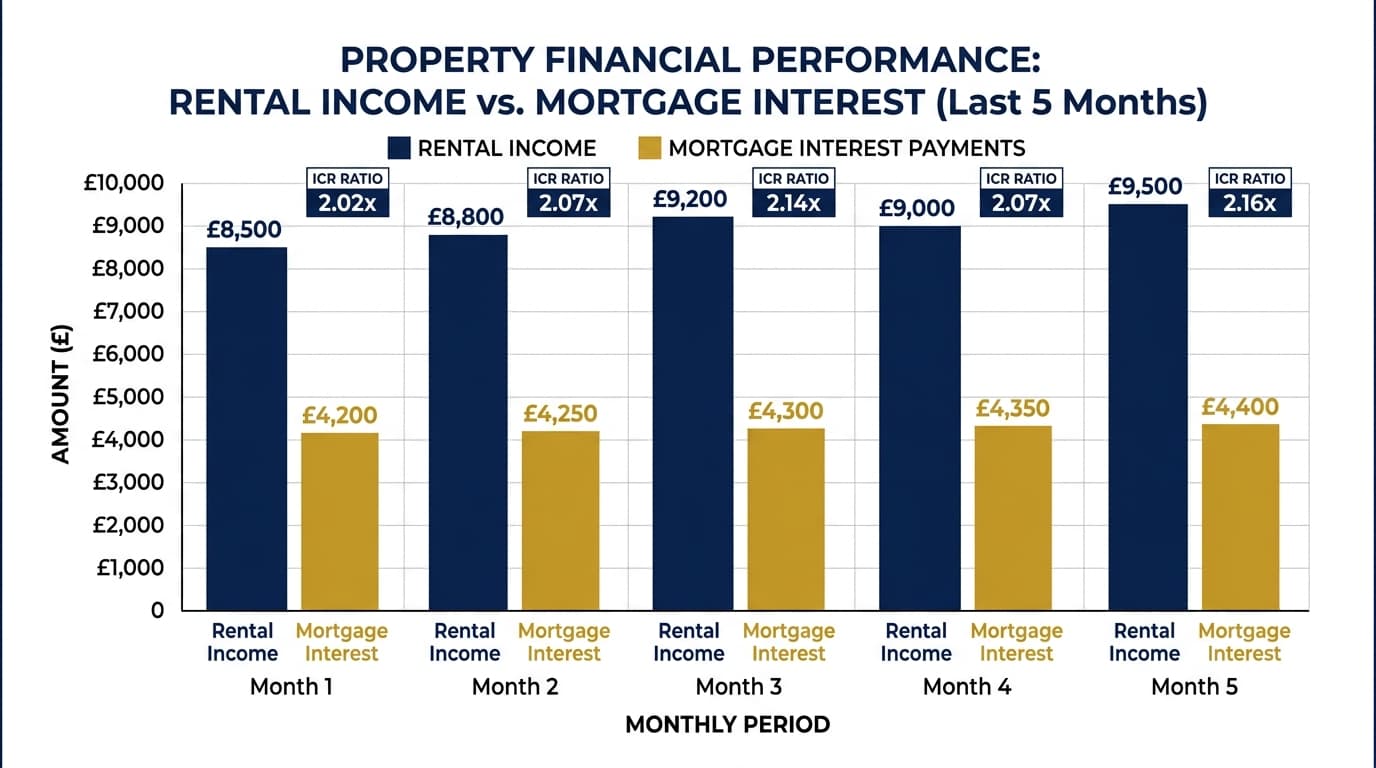
Lenders require rental income to cover mortgage interest by a specified multiple — typically 125-150%. This test limits the loan size based on affordability:
Maximum interest-only loan = Annual rent ÷ (Interest rate × Coverage ratio)
Example: Annual rent £28,000, interest rate 6%, coverage ratio 1.25:
Maximum loan = £28,000 ÷ (6% × 1.25) = £28,000 ÷ 7.5% = £373,333
For more detail on this calculation, see our guide to SSAS debt service coverage.
Step 5: Identify the Binding Constraint
You now have up to four potential limits on your borrowing:
- HMRC maximum borrowing headroom
- Lender's LTV-based maximum advance
- Income coverage test maximum loan
- The deposit constraint (scheme cash must cover purchase price minus loan plus costs)
Your effective maximum borrowing is the lowest of all applicable limits. This is the binding constraint that your deal structure must satisfy.
Matt Lenzie notes: "In most SSAS deals I've worked on, the binding constraint switches between the HMRC cap and the income coverage test depending on the specific scheme and property. It's rarely the LTV ratio alone."
Worked Example: Four-Member SSAS
Let's work through a complete example:
Scheme assets:
- Existing property (market value): £700,000
- Cash: £200,000
- Quoted investments: £100,000
- Loanback receivable: £50,000
- Total assets: £1,050,000
Scheme liabilities:
- Existing mortgage: £320,000
- Total liabilities: £320,000
Net asset value: £1,050,000 − £320,000 = £730,000
HMRC maximum total borrowing: 50% × £730,000 = £365,000
Existing borrowing: £320,000
HMRC additional borrowing headroom: £365,000 − £320,000 = £45,000
Target property: £300,000 industrial unit, annual rent £21,000
Lender LTV maximum (70%): £300,000 × 70% = £210,000
Income coverage maximum (6% rate, 1.25× ICR): £21,000 ÷ 7.5% = £280,000
Binding constraint: HMRC headroom of £45,000 — by far the lowest.
In this case, the scheme would need to either reduce existing borrowing, grow its asset base through contributions, or consider a cash purchase of the new property. The lender could theoretically advance £210,000 but the HMRC cap restricts additional borrowing to just £45,000.
Strategies to Increase Borrowing Power
If the HMRC cap is the binding constraint, strategies to expand headroom include:
- Member and employer contributions: Every pound contributed increases net asset value and therefore the 50% cap. Four members contributing £15,000 each = £60,000 new assets = £30,000 new borrowing headroom.
- Professional revaluation of existing property: If existing property has appreciated, an updated valuation increases net assets and therefore headroom.
- Repaying existing borrowing: Reduces liabilities, increasing net asset value and headroom.
- Retiring loanbacks: If the sponsoring employer repays an outstanding loanback, this also reduces scheme liabilities (if the loanback was treated as a liability) or increases cash (if it was an asset being repaid).
If the income coverage test is the binding constraint, the solution usually involves looking for higher-yielding properties or properties where the rent can be increased to market levels.
Using the SSAS Mortgage Calculator
Our SSAS mortgage calculator automates these calculations. Input your scheme's total assets, existing borrowing, target property value, expected rent, and the calculator will identify your HMRC headroom and model likely lender terms.
Key Takeaways
- Two separate calculations determine your borrowing power: the HMRC 50% cap on net assets and the lender's LTV and income coverage tests
- The effective maximum is the lowest of all applicable limits
- In our experience, the HMRC cap or income coverage test — not the LTV ratio — is usually the binding constraint
- Contributions, revaluations, and existing debt repayment all expand HMRC headroom
- Model all four constraints before committing to any transaction
Model Your SSAS Borrowing Power
Our team can run through this calculation with your specific scheme details and target property to give you a precise picture of what's achievable.
Contact us today for a no-obligation assessment, or start with our SSAS mortgage calculator.
About the Author
Matt Lenzie
Former Banker & Corporate Finance Partner
Matt Lenzie is a former banker and corporate finance partner with extensive experience in pension-backed property transactions. He founded SSAS Property Finance to help company directors and trustees navigate the complexities of commercial property acquisition through Small Self-Administered Schemes.