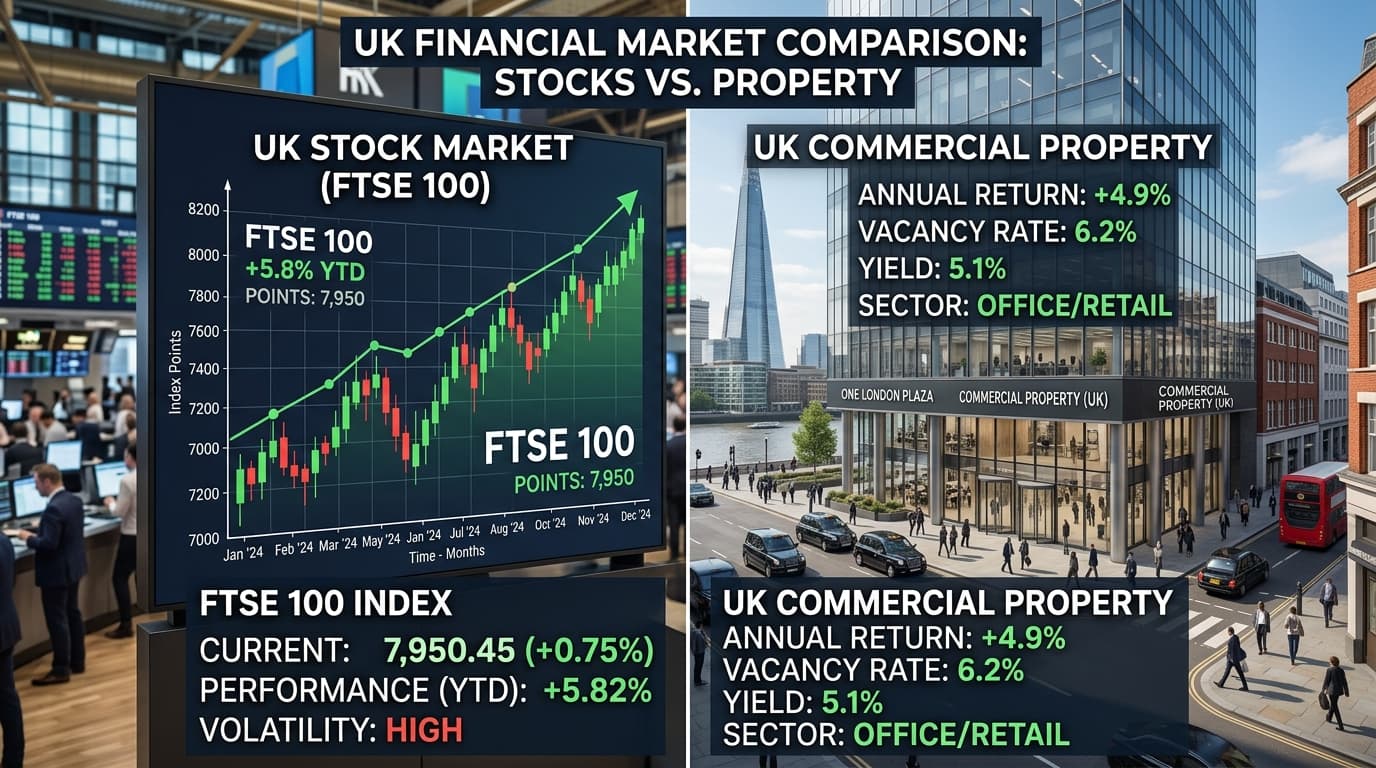
SSAS Investment Diversification: Beyond Property
Written by Matt Lenzie
Former Banker & Corporate Finance Partner
SSAS Investment Diversification: How to Balance Property with Other Assets
Commercial property is often the centrepiece of an SSAS investment strategy — and for good reason. The tax efficiency, income generation, and potential for capital appreciation make it uniquely attractive when held inside a pension scheme. But concentration in a single asset class, particularly one as illiquid as commercial property, carries real risks that should not be underestimated.
This guide explores how SSAS trustees can achieve genuine diversification — balancing commercial property with other permitted investments to create a more resilient pension portfolio.
Why Diversification Matters in an SSAS
SSAS trustees are required to act in the best interests of all scheme members. A fundamental principle of prudent investment is diversification — spreading risk across different asset classes so that underperformance in one area does not devastate the scheme's overall value.
The risks of over-concentration in commercial property are:
- Illiquidity: Commercial property cannot be sold quickly. If members need to draw pension benefits at a time when the property market is weak or the property is vacant, the scheme may be unable to meet its obligations without a forced sale at a poor price.
- Sector correlation: If the sponsoring employer's business struggles (perhaps because of a sector downturn), the connected party tenant may struggle to pay rent at exactly the same time as the business may be unable to make contributions. Both income streams could be affected simultaneously.
- Concentration in a single location: A scheme that owns all its property in one geographic area is exposed to local market risk — a new bypass, a major employer leaving the area, or a planning decision can all affect values.
"We see SSAS schemes where 95% of assets are in a single commercial property leased to the sponsoring employer. That can work well for many years — but it is a fragile structure. The best-run schemes we work with maintain at least 20-30% in liquid or near-liquid assets at all times." — Matt Lenzie
What Can an SSAS Invest In?
An SSAS has much broader investment powers than most pension products. Permitted investments include:
- Commercial property: Offices, industrial, retail, mixed-use — the core SSAS investment for many schemes
- Listed equities: UK and international stocks, either directly or via funds and ETFs
- Fixed income: Government bonds (gilts), corporate bonds, and bond funds
- Cash: Bank deposits and money market funds — essential for scheme liquidity
- Collective investment schemes: Unit trusts, OEICs, investment trusts
- Commercial loans: The SSAS can lend to the sponsoring employer (the loanback) within HMRC's prescribed limits
- Unlisted shares: Under certain conditions, SSAS schemes can hold shares in unquoted companies — though this carries specific risks and restrictions
What an SSAS cannot invest in directly includes residential property, tangible moveable property (art, wine, cars), and certain other "taxable property" categories as defined by HMRC.
Building a Diversified SSAS Portfolio: A Framework
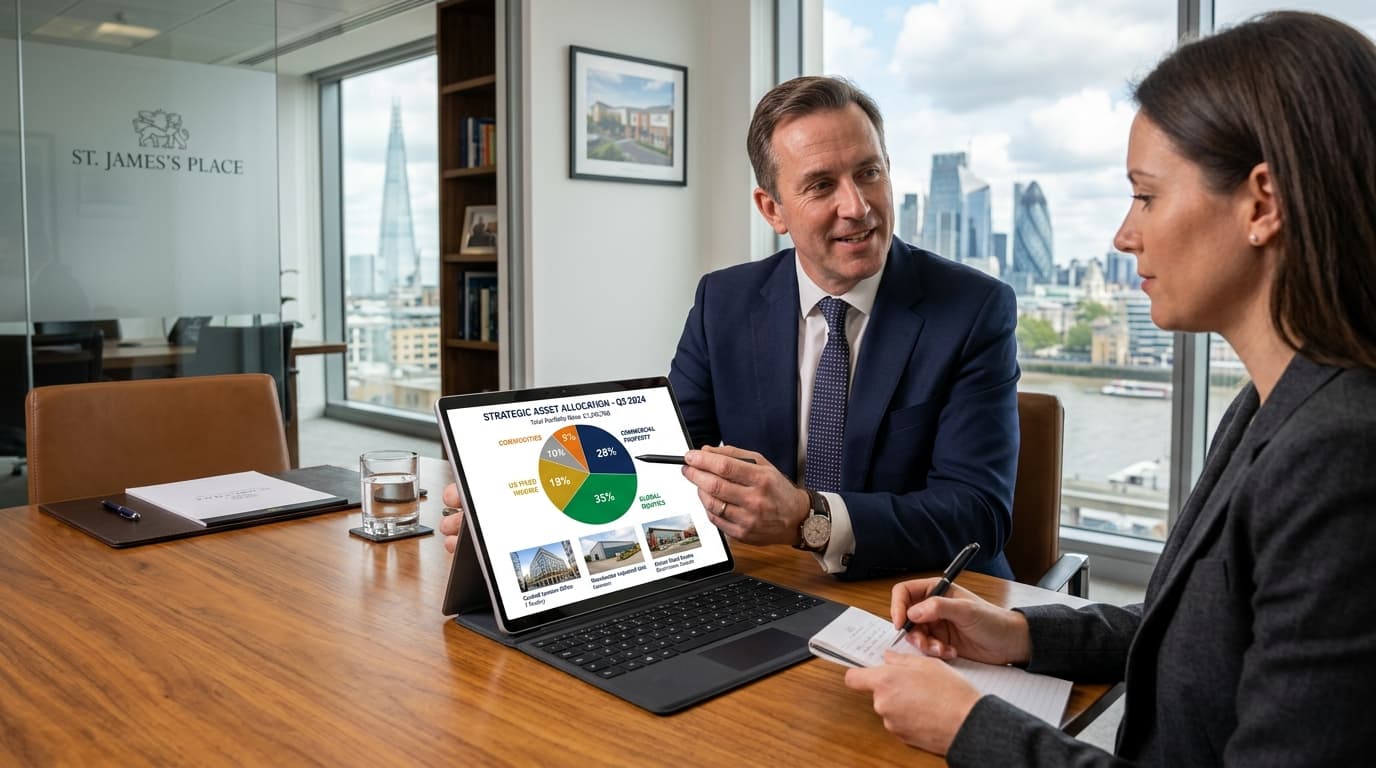
A practical diversification framework for a mature SSAS with a core commercial property holding might look like this:
- 60-70% commercial property: Existing commercial property holdings, which generate the scheme's primary income stream
- 15-20% listed equities and funds: Growth-oriented investments that provide long-term capital appreciation and dividends without the management burden of direct property
- 10-15% fixed income: Gilts and high-quality corporate bonds that provide a predictable income stream and act as a counterweight to equity volatility
- 5-10% cash: Held as a liquidity buffer to cover mortgage payments, contribution shortfalls, and benefit payments without forcing a property sale
The right allocation will depend on the members' ages, the proximity of benefit crystallisation, the income requirements of the scheme, and the trustees' collective risk appetite. It is not a one-size-fits-all formula.
The Role of Cash and Liquidity
Cash is often undervalued as a SSAS asset — but in our experience, adequate cash reserves are the difference between a scheme that navigates difficult periods smoothly and one that is forced into decisions it would not otherwise make.
A cash buffer of at least three to six months of mortgage payments and anticipated benefit payments is a sensible minimum. For schemes where member ages suggest benefit crystallisation within five years, a larger cash or near-liquid allocation is appropriate.
When interest rates are elevated (as they have been since 2022), holding cash in money market funds or fixed-term deposits provides a meaningful real return while preserving liquidity — making the case for cash even stronger than during periods of near-zero rates.
Listed Equities: Growth Without the Management Burden
Unlike commercial property, listed equities require no active management from trustees. A diversified equity portfolio — held via index funds or actively managed funds — provides exposure to economic growth across multiple sectors and geographies without lease negotiations, rent reviews, or structural surveys.
Within the SSAS, dividends and capital gains from listed investments are sheltered from income tax and capital gains tax — just as rental income and property appreciation are. This makes the pension wrapper equally powerful for listed asset investment as it is for property.
A common approach for SSAS schemes is to appoint a discretionary investment manager for the listed asset portion of the scheme — a professional who manages the equity and bond portfolio according to an agreed risk mandate, freeing the trustees to focus on the property assets.
Rebalancing Over Time
As a SSAS property portfolio grows (through capital appreciation), the property allocation naturally increases as a proportion of total scheme assets. Periodic rebalancing — shifting some property-generated income or contribution receipts into the liquid portfolio — maintains the target allocation and prevents drift towards dangerous over-concentration.
Rebalancing should be considered at the annual trustee investment review. For schemes approaching benefit crystallisation, the rebalancing process should deliberately increase the liquid proportion to prepare for pension payments.
For more on strategic planning for the long term, read our guide on SSAS long-term wealth strategy. For guidance on the property side of the portfolio, visit our SSAS property finance hub.
Key Takeaways
- Over-concentration in commercial property creates illiquidity and correlation risks
- An SSAS can hold equities, bonds, cash, and commercial loans alongside property
- A cash buffer covering 3-6 months of outgoings is a minimum prudent standard
- Listed investments require no active management and benefit equally from the pension tax wrapper
- Rebalance annually and deliberately increase liquid allocations as retirement approaches
Review Your SSAS Investment Mix
If your SSAS is heavily concentrated in a single commercial property, it may be time to review your overall investment strategy. Speak to our team about how to build a more resilient and diversified pension portfolio.
About the Author
Matt Lenzie
Former Banker & Corporate Finance Partner
Matt Lenzie is a former banker and corporate finance partner with extensive experience in pension-backed property transactions. He founded SSAS Property Finance to help company directors and trustees navigate the complexities of commercial property acquisition through Small Self-Administered Schemes.