SSAS Long-Term Wealth Strategy: A 20-Year Framework
Written by Matt Lenzie
Former Banker & Corporate Finance Partner
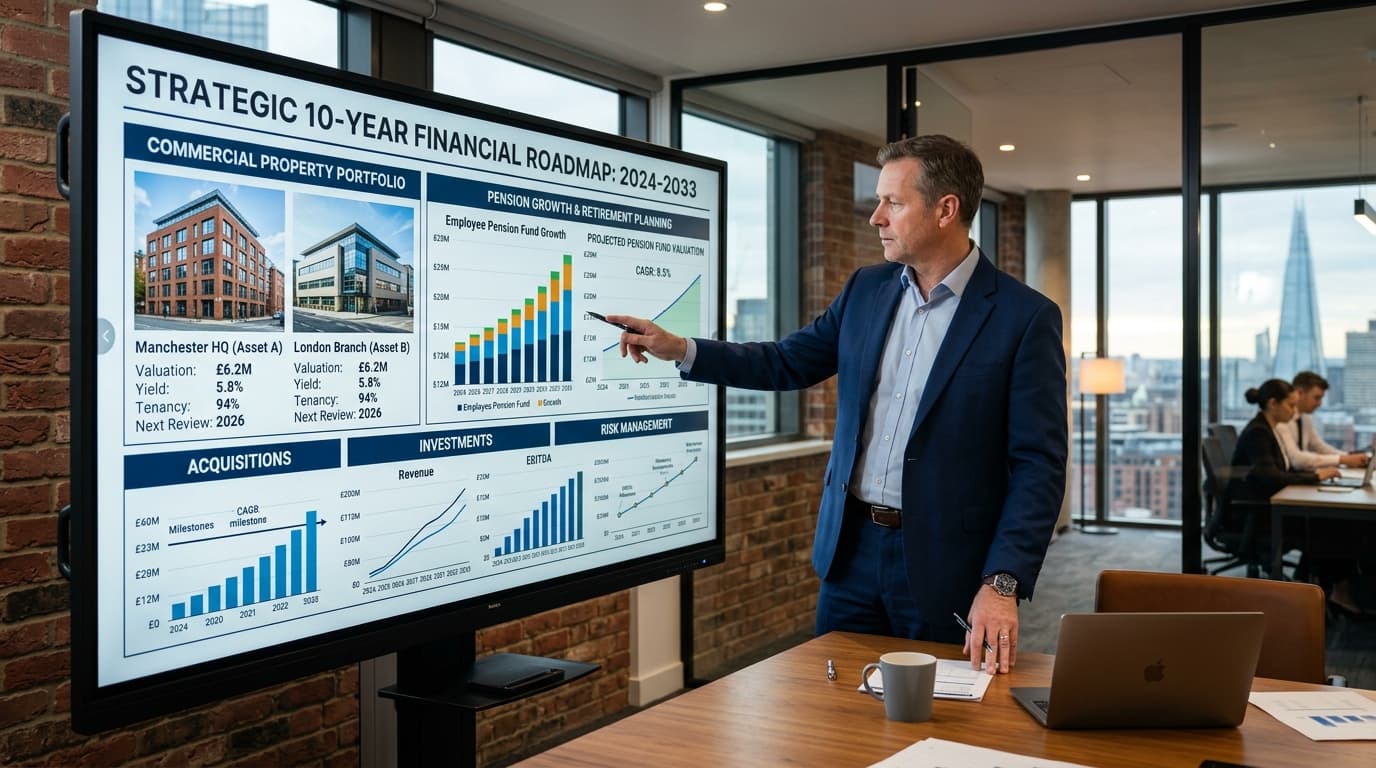
SSAS Long-Term Wealth Strategy: A 20-Year Framework
The SSAS is a long-game vehicle. Its true power — the compounding of tax-free income, the accumulation of capital gains within the pension wrapper, and the eventual generation of sustainable retirement income — only becomes fully visible over a 15-20 year investment horizon. Directors who establish an SSAS at 40, build it thoughtfully for 20 years, and draw on it from 60 can create a retirement income and wealth legacy that would be extraordinarily difficult to replicate through any other legal structure.
This guide sets out a framework for thinking about the full 20-year SSAS journey — from establishment through accumulation, portfolio building, transition to decumulation, and succession planning.
Phase 1: Establishment and Foundation (Years 1-3)
The first phase is about getting the fundamentals right. The decisions made in this phase will determine the quality of the platform on which everything else is built.
Key actions in Phase 1:
- Establish the SSAS with a reputable professional trustee and experienced scheme administrator
- Register the scheme with HMRC and set up scheme banking and investment accounts
- Begin making employer contributions — aim for the maximum permitted level relative to the company's profit. Use carry-forward provisions to maximise contributions in high-profit years
- If eligible, transfer in existing personal pension funds (taking advice on protected benefits first)
- Consider making the first property investment if the scheme has sufficient assets (typically £200,000+ in liquid assets before a first purchase)
Target by end of Phase 1: A well-established, HMRC-registered scheme with at least £300,000-£500,000 in assets (depending on contribution levels and any transfers), and ideally a first commercial property in the portfolio.
For guidance on the first property purchase, read our complete first-time buyer walkthrough.
Phase 2: Accumulation and First Portfolio Build (Years 4-10)
The accumulation phase is where the compounding power of the SSAS becomes tangible. Consistent employer contributions, reinvested rental income, and property capital growth combine to grow the scheme's asset base significantly during this period.
Key actions in Phase 2:
- Continue maximum employer contributions, adjusting for business cashflow
- Reinvest net rental income (above mortgage interest) into liquid investments within the scheme
- Conduct scheduled rent reviews to capture rental growth in the property's value
- By years 5-7, consider whether the existing property can be refinanced to release equity for a second acquisition (see our refinance case study)
- Make the second property acquisition when scheme assets and income support it
- Begin diversifying the liquid asset portfolio across equities and bonds alongside property
"The accumulation phase is the foundation of everything. We consistently see that schemes which are disciplined about contributions in years 3-10 — even when business conditions are challenging — have dramatically better outcomes at retirement than those that treat the SSAS as an afterthought in good years and stop contributing in bad ones." — Matt Lenzie
Target by end of Phase 2: A scheme with £1m-£2m in total assets (depending on property appreciation and contribution levels), at least two commercial properties, and a growing liquid investment portfolio providing diversification.
Phase 3: Portfolio Maturity and Optimisation (Years 11-15)
By the midpoint of the 20-year framework, the scheme's commercial property portfolio should be generating significant income. The focus in this phase shifts from maximum accumulation towards optimisation — ensuring the portfolio composition, tenant quality, and lease structure are positioned for maximum value and income sustainability.
Key actions in Phase 3:
- Commission fresh RICS valuations of all properties to understand current market values
- Assess each property's investment case individually: is the tenant covenant strong? Is the unexpired lease term adequate? Is the sector performing well?
- Consider selling underperforming assets and reinvesting proceeds in higher-quality properties
- Review the connected party lease terms — are rents still at market levels? Have rent reviews been conducted correctly?
- Begin modelling retirement income needs — what income will the scheme need to generate, and when?
- Consider whether to begin capital repayment on some mortgages (rather than interest-only) to improve the scheme's equity position ahead of retirement
Target by end of Phase 3: A mature, income-generating portfolio of 2-4 commercial properties with a clear view of the income each will produce in retirement, and a solid liquid asset buffer supporting the overall scheme.
Phase 4: Transition to Decumulation (Years 16-20)
As retirement approaches, the strategy must evolve from building assets to deploying them for retirement income. This is the most critical phase from a planning perspective — errors here can be costly and hard to reverse.
Key actions in Phase 4:
- Model the required retirement income carefully — how much pension drawdown will be needed each year, in the context of other income sources (state pension, business dividends, spouse's income)?
- Ensure sufficient cash liquidity within the scheme to fund the pension commencement lump sum (up to 25% of crystallised fund value) without forcing a property sale
- Begin the process of selling any properties that will not form part of the long-term retirement income portfolio — allow 18-24 months for a quality sale process
- Engage an independent financial adviser for detailed retirement income planning across all assets
- Review and update beneficiary nominations — especially if family circumstances have changed
- Consider whether to add next-generation family members to the SSAS for succession planning purposes
Target by end of Phase 4: A scheme that is ready to deliver sustainable retirement income — with the right properties retained (or all properties sold and proceeds invested in income-generating assets), sufficient cash liquidity, and a clear succession plan.
Phase 5: Retirement Income and Succession (Ongoing)
In retirement, the SSAS continues to operate — holding assets, collecting rent, managing mortgages (if any remain), and distributing income to members in drawdown. The focus is on sustainability: ensuring the income continues reliably year after year, managing tenant risk, and planning for the eventual transfer of remaining scheme assets to the next generation.
For detailed guidance on each of these dimensions, read our articles on SSAS retirement income from property, SSAS property exit strategies, and SSAS succession planning.
The 20-Year Wealth Building Summary
To illustrate the potential of a disciplined SSAS strategy over 20 years, consider the following illustrative scenario:
- Year 1 starting assets: £250,000 (cash from transfers and initial contributions)
- Annual employer contributions: £40,000
- First property purchase in Year 2: £400,000 (50% LTV)
- Second property in Year 7: £500,000 (using refinance equity plus accumulated contributions)
- Property appreciation: 3.5% per year average across both properties
- Rental yield: 7% on market value
By Year 20, the illustrative scheme might hold:
- Two commercial properties with a combined value of approximately £1.4m
- Net equity in properties (after mortgage repayment or reduction): approximately £900,000
- Liquid investment portfolio: approximately £400,000
- Total scheme net assets: approximately £1.3m
- Annual rental income: approximately £100,000
All of this growth occurred within a tax-free pension wrapper. The equivalent portfolio held outside a pension would have been significantly smaller after income tax on rent, CGT on appreciation, and the loss of employer contribution deductibility.
Key Takeaways
- The SSAS 20-year journey has five distinct phases, each with specific strategic priorities
- Consistent, maximum employer contributions in the accumulation phase are the most important driver of long-term outcomes
- Portfolio optimisation at the midpoint prevents the scheme from drifting with underperforming assets
- Transition to decumulation requires detailed planning — start at least 5 years before retirement
- Succession planning should be integrated throughout the strategy, not added as an afterthought
Start Your 20-Year Strategy Today
Whether you are at the beginning of your SSAS journey or well into it, our team can help you build and execute a coherent long-term strategy. Get in touch for a strategic conversation, or explore our SSAS property finance hub for more on the investment options available.
About the Author
Matt Lenzie
Former Banker & Corporate Finance Partner
Matt Lenzie is a former banker and corporate finance partner with extensive experience in pension-backed property transactions. He founded SSAS Property Finance to help company directors and trustees navigate the complexities of commercial property acquisition through Small Self-Administered Schemes.