SSAS Property vs Equities: Which Delivers Better Pension Returns?
Written by Matt Lenzie
Former Banker & Corporate Finance Partner
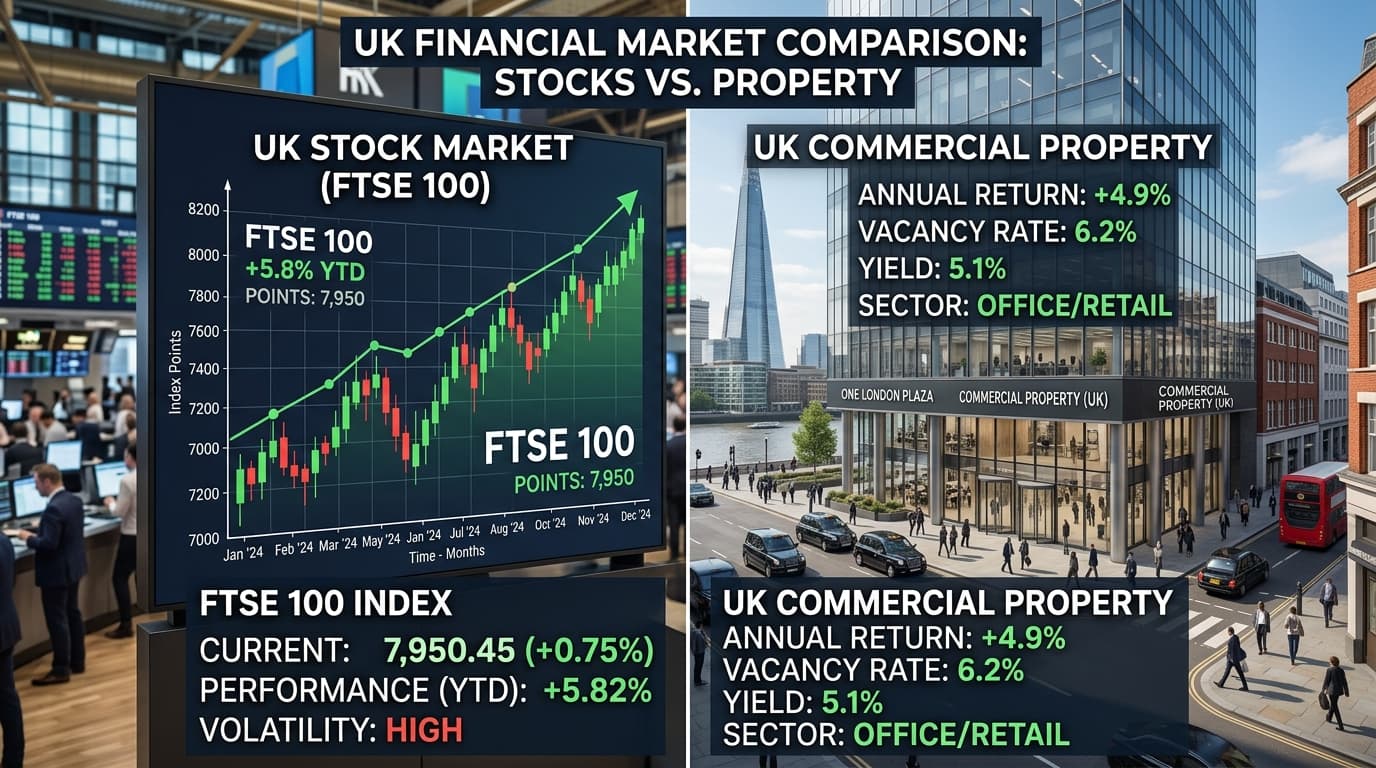
SSAS Property vs Equities: Making the Right Investment Choice
When SSAS trustees consider how to invest their pension assets for maximum long-term growth, two asset classes dominate the conversation: commercial property and listed equities. Both offer compelling characteristics within the pension wrapper — but they have very different risk profiles, liquidity characteristics, and operational requirements. Understanding the differences is essential for making informed investment decisions.
Historical Returns: The Evidence Base
Over the long term, both asset classes have delivered strong real returns (above inflation), but with notable differences in consistency and volatility.
UK commercial property has delivered average total returns (income plus capital) of approximately 7-8% per year over the past 25 years, according to the MSCI UK Annual Property Index. This figure masks significant variation by sector: industrial and logistics properties have outperformed the market substantially in recent years, while retail (particularly high street retail) has underperformed significantly.
UK equities (as measured by the FTSE All-Share) have delivered average total returns of approximately 7-9% per year over the same period — slightly higher in good years, but with much greater short-term volatility. Global equities (particularly US equities) have delivered even higher returns over this period, though currency exposure adds another layer of risk for UK investors.
On pure return figures, equities have a slight edge historically — but the comparison is not straightforward when commercial property held within an SSAS is occupied by the sponsoring employer.
"For business owners with an SSAS, the comparison between property and equities is not just about investment returns. The connected party lease structure means that the business's rent payments directly fund the pension scheme — creating a guaranteed income stream that no equity portfolio can replicate. That changes the calculus significantly." — Matt Lenzie
The Connected Party Advantage: Property's Unique Benefit
For SSAS trustees who also own the sponsoring employer, commercial property offers something that equities cannot: the ability to redirect business expenditure (rent) directly into the pension scheme.
Consider two scenarios for a business paying £40,000 per year in commercial premises costs:
Scenario A (Equities): The business pays rent to a third-party landlord. After corporation tax relief, the net cost is £30,000 (at a 25% tax rate). The SSAS holds equities generating a 7% annual return on its assets.
Scenario B (Property): The SSAS owns the property and receives £40,000 per year in rent. After corporation tax relief, the net business cost is still £30,000 — but the £40,000 flows into the pension scheme tax-free, growing the retirement pot directly.
The pension scheme effectively captures the full pre-tax rent figure, rather than the post-tax net cost to the business. This structural advantage is unique to the SSAS connected party lease model.
Risk Profile: Volatility vs Illiquidity
The risk profiles of the two asset classes are fundamentally different:
Equities offer high liquidity (shares can typically be sold within one trading day) but high short-term price volatility. A market correction can see equity values fall 20-40% in a matter of months — as happened in 2020 (Covid), 2008 (global financial crisis), and 2000-2002 (dot-com bust). For pension schemes nearing benefit crystallisation, this volatility can be devastating to retirement outcomes.
Commercial property offers much lower short-term price volatility (values move more slowly because properties are infrequently traded) but very high illiquidity. Selling a commercial property typically takes months. If a scheme needs cash quickly, it may be unable to realise property assets without accepting a price discount.
The right answer for most SSAS schemes is a blend of both: property for its income generation, connected party advantage, and lower volatility; equities for their liquidity, long-term growth potential, and ease of management.
Tax Efficiency: A Level Playing Field
One area where the comparison is genuinely equal: both asset classes benefit equally from the pension tax wrapper. Within an SSAS:
- Rental income from property is free from income tax
- Dividends from equities are free from income tax
- Capital gains on property are free from capital gains tax
- Capital gains on equity sales are free from capital gains tax
The pension wrapper eliminates the tax that would otherwise reduce investment returns on both asset classes. This makes the pension environment the ideal holding structure for both.
Operational Considerations: Passive vs Active
Equities held via index funds or managed funds require almost no active input from SSAS trustees. Set up the mandate, appoint an investment manager, and review quarterly. The management burden is minimal.
Commercial property is fundamentally an active investment. Tenants must be managed, leases reviewed, rent collected, repairs overseen, and mortgage obligations met. For trustees who are running a business alongside managing an SSAS, the additional time commitment of direct property ownership is a real consideration.
This is not an argument against property investment — the returns and structural benefits often justify the additional workload. But it should be recognised honestly when comparing the two asset classes.
Optimal SSAS Portfolio: The Case for Blending
In practice, the strongest SSAS investment strategies do not choose between property and equities — they blend both in proportions appropriate to the scheme's size, members' ages, and investment objectives.
A typical framework might be:
- Core commercial property (connected party and/or third-party): 60-70% of scheme assets
- Listed equities (via funds): 15-20% of scheme assets
- Fixed income/bonds: 5-10% of scheme assets
- Cash/liquidity buffer: 5-10% of scheme assets
This allocation delivers the connected party structural advantage, diversified income streams, and sufficient liquidity to manage benefit payments and any property-related contingencies.
For more on building a diversified SSAS portfolio, read our guide on SSAS investment diversification. For an overview of how commercial property works within an SSAS, visit our SSAS property finance hub.
Key Takeaways
- Both commercial property and equities have delivered strong historical returns within pension schemes
- The connected party lease gives property a unique structural advantage for business owner SSAS trustees
- Property has lower volatility but higher illiquidity; equities have higher volatility but excellent liquidity
- The pension tax wrapper eliminates income tax and CGT on both asset classes equally
- A blended approach delivers the best of both worlds for most SSAS members
Review Your SSAS Investment Strategy
If you are deciding how to invest your SSAS assets — or reviewing an existing allocation — our team can help you think through the strategic options. Get in touch for a no-obligation conversation about what is right for your scheme.
About the Author
Matt Lenzie
Former Banker & Corporate Finance Partner
Matt Lenzie is a former banker and corporate finance partner with extensive experience in pension-backed property transactions. He founded SSAS Property Finance to help company directors and trustees navigate the complexities of commercial property acquisition through Small Self-Administered Schemes.