SSAS Loanback Interest Rate Rules: Base Rate Plus 1%
Written by Matt Lenzie
Former Banker & Corporate Finance Partner
The Minimum Interest Rate Requirement
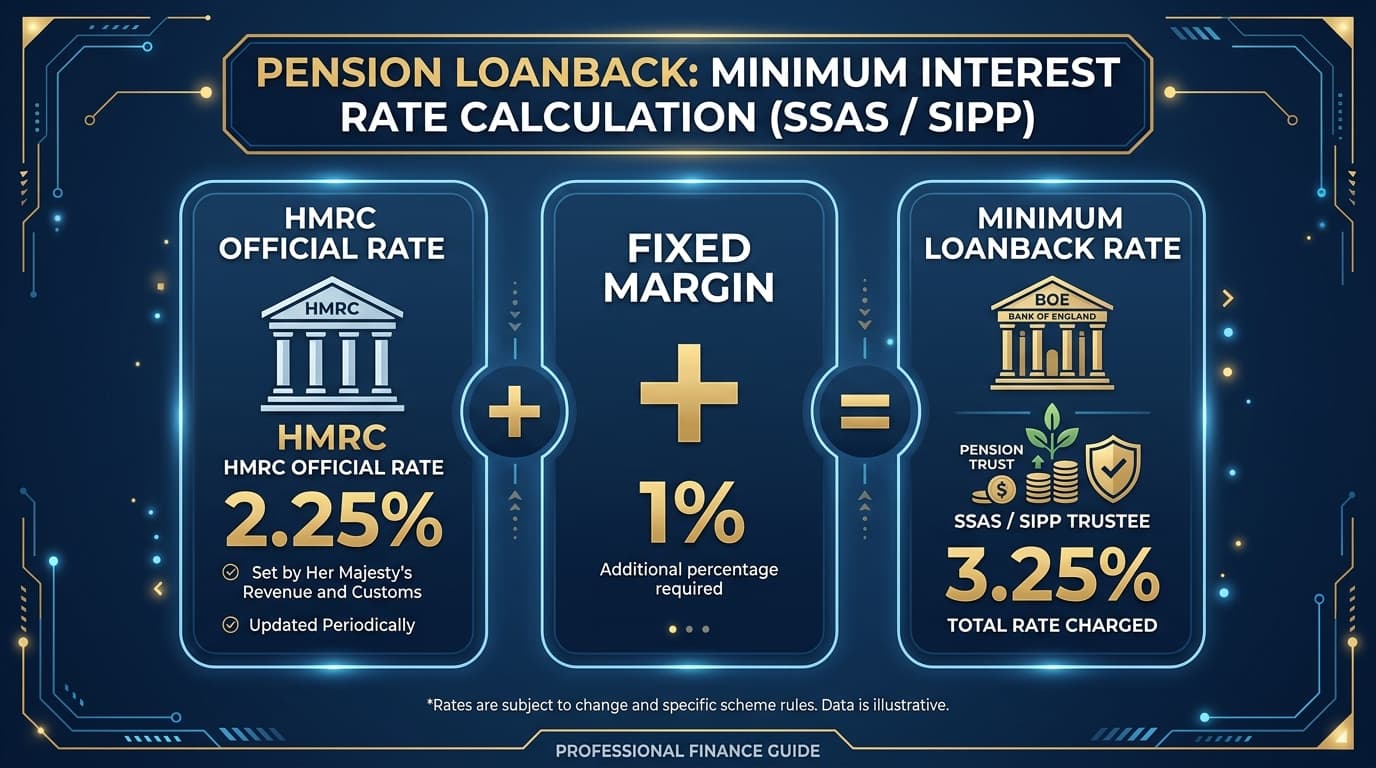
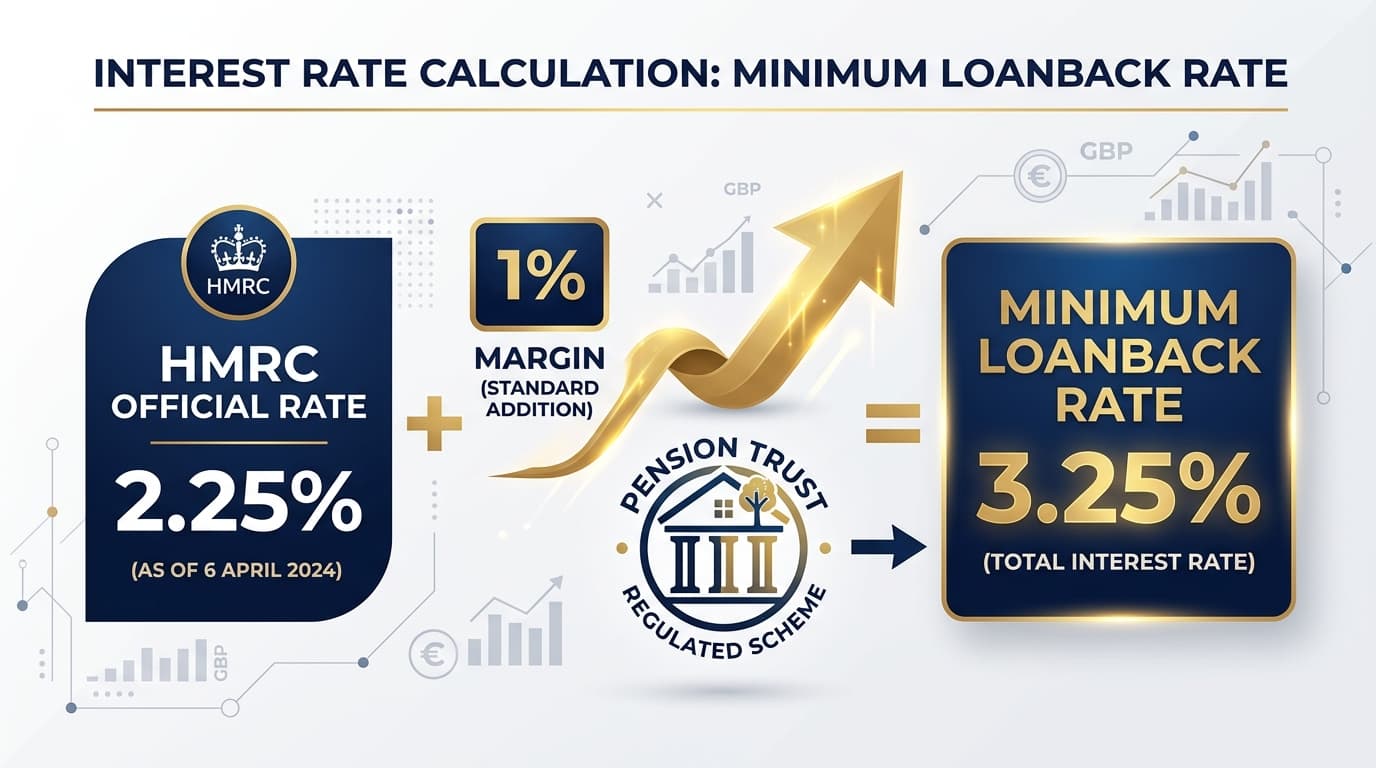
HMRC requires that every SSAS loanback charges interest at a rate no less than 1% above the "official rate." The official rate is set by HMRC and is currently 2.25% (as at the 2025/26 tax year), making the minimum loanback interest rate 3.25%.
This requirement exists to prevent the pension scheme from effectively subsidising the employer with a below-market loan — which would constitute a disguised benefit to the business at the expense of other pension members.
For context on how this fits into the broader loanback rules, see our comprehensive guide to SSAS loanback rules.
What Is the "Official Rate"?
The official rate is set by HMRC under the Income Tax (Earnings and Pensions) Act 2003 and is reviewed periodically. Historically it moved relatively rarely, but in recent years HMRC has updated it more frequently to track market rates.
Current official rate: 2.25% (2025/26)
Minimum SSAS loanback rate: 2.25% + 1% = 3.25%
Important: The minimum rate is a floor, not a ceiling. Trustees can charge a higher interest rate if they consider it appropriate for the scheme's investment objectives. In practice, most loanbacks are arranged at the minimum rate because the employer-trustee relationship makes it commercially reasonable — the business is effectively paying into the pension via interest payments.
Why Does Interest Flow Back to the Pension?
A key feature of the loanback is that the interest paid by the employer flows directly back into the pension scheme as investment income. This is one of the most attractive aspects of the loanback structure:
- For the employer: The interest is a business expense, potentially deductible for corporation tax purposes
- For the pension scheme: The interest is received tax-free (pension schemes pay no income tax on investment returns)
- For members: The interest income grows within the tax-exempt pension environment
Matt Lenzie notes: "The loanback is effectively a mechanism to convert taxable business income (which would otherwise generate corporation tax) into pension fund growth. Every pound of interest the business pays reduces taxable profits by one pound — and that same pound arrives in the pension scheme tax-free. That's a powerful wealth transfer mechanism for business owners."
Fixed vs. Variable Interest Rates
The loanback interest rate can be structured as either:
Fixed Rate
Set at the outset and maintained throughout the loan term. The rate must be at least the official rate plus 1% at the time of the loan — it does not need to track subsequent changes to the official rate. This provides certainty for both the employer and the scheme.
Variable Rate
Linked to the official rate, updating when HMRC changes it. The rate always stays at least 1% above the official rate. This introduces some uncertainty for the employer but ensures the scheme always receives a genuinely commercial rate.
Most SSAS loanbacks use a fixed rate for administrative simplicity. If the official rate rises significantly during the loan term, a fixed rate loanback could in theory fall below "base rate plus 1%" — but HMRC's guidance suggests the compliance test is met at the time the loan is made, not on a continuous basis, provided the rate was set correctly at inception.
How Interest Is Calculated on a Reducing Balance
Because loanback repayments reduce the outstanding principal over time, the interest charged each period falls accordingly. The loan is structured like a standard amortising loan:
- Year 1: Interest on the full loan balance
- Year 2: Interest on the balance remaining after Year 1 repayments
- Year 3-5: Continuing reduction as capital is repaid
For a £150,000 five-year loanback at 3.25% interest with annual capital repayments of £30,000:
- Year 1 interest: £150,000 × 3.25% = £4,875
- Year 2 interest: £120,000 × 3.25% = £3,900
- Year 3 interest: £90,000 × 3.25% = £2,925
- Year 4 interest: £60,000 × 3.25% = £1,950
- Year 5 interest: £30,000 × 3.25% = £975
- Total interest paid: £14,625
All £14,625 flows into the pension scheme as investment income, growing tax-free alongside the scheme's other assets.
For a full worked example including both capital and interest repayments, see our SSAS loanback worked example guide.
What Happens If the Wrong Rate Is Charged?
Charging below the minimum rate — or failing to charge interest at all — is treated by HMRC as a breach of the permitted loanback conditions. The entire outstanding loan balance (not just the underpaid interest) may be reclassified as an unauthorised payment, with all the associated tax penalties.
If an error is discovered, the trustees should seek specialist tax advice immediately. HMRC has a voluntary disclosure process that can mitigate penalties in some circumstances — but acting quickly is essential.
Interest Rate Comparison: Loanback vs. Bank Borrowing
How does the minimum loanback rate of 3.25% compare to commercial bank borrowing for small businesses?
- Typical bank overdraft rate for SMEs: 8-15% above base rate
- Unsecured business loan: 6-18% per annum
- Secured business loan: 4-8% per annum
- SSAS loanback minimum: 3.25% per annum (2025/26)
In many scenarios, the SSAS loanback rate is materially lower than available bank alternatives — particularly for businesses that may not qualify for the lowest bank rates.
However, the comparison isn't purely about rate. The loanback's interest flows into the pension scheme rather than to a bank, which is a distinctive advantage. For a full comparison, see our guide to SSAS loanback vs mortgage.
Tax Treatment of Loanback Interest for the Employer
Provided the loanback is on genuinely commercial terms (including the minimum interest rate), the interest paid by the employer is typically deductible as a business expense for corporation tax purposes. However:
- The interest must be "wholly and exclusively" for business purposes
- The loan must not be used for non-business purposes
- If the loan is used for mixed purposes, interest deductibility may be restricted
Always confirm the tax treatment with your accountant before drawing a loanback.
Key Takeaways
- The minimum loanback interest rate is the HMRC official rate (currently 2.25%) plus 1% = 3.25% minimum
- Interest can be fixed at the outset or variable, but must always be at least the minimum
- All interest paid flows into the pension scheme as tax-free investment income
- Charging below the minimum rate risks reclassification of the entire loan as an unauthorised payment
- The loanback rate is often materially lower than available bank alternatives
Structure Your SSAS Loanback Correctly
Getting the interest rate right is just one of several compliance requirements for SSAS loanbacks. Our team can help you structure every aspect of the loanback correctly from the outset.
Contact us today for expert guidance, or review our complete SSAS loanback compliance checklist.
About the Author
Matt Lenzie
Former Banker & Corporate Finance Partner
Matt Lenzie is a former banker and corporate finance partner with extensive experience in pension-backed property transactions. He founded SSAS Property Finance to help company directors and trustees navigate the complexities of commercial property acquisition through Small Self-Administered Schemes.