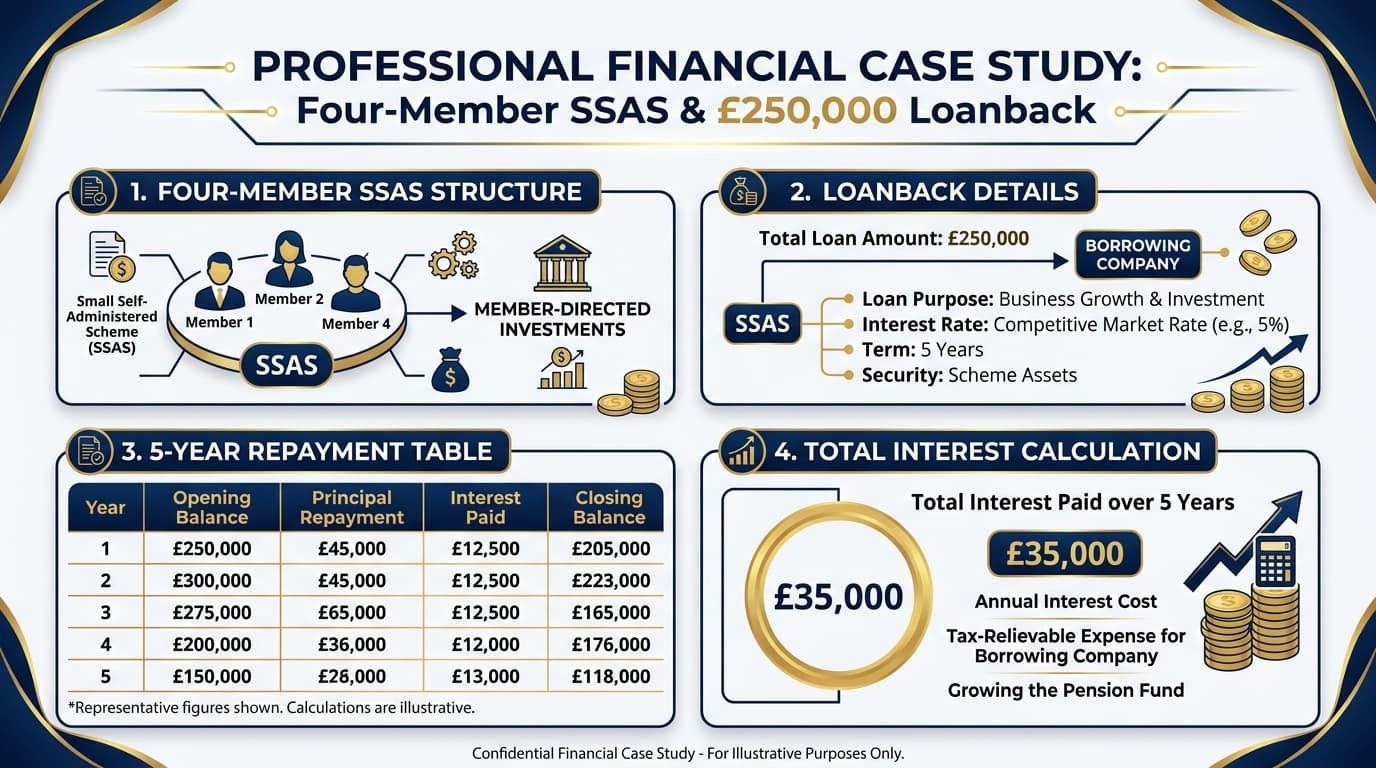
SSAS Loanback Repayment Schedule: Structuring Equal Instalments
Written by Matt Lenzie
Former Banker & Corporate Finance Partner
The Equal Instalment Requirement
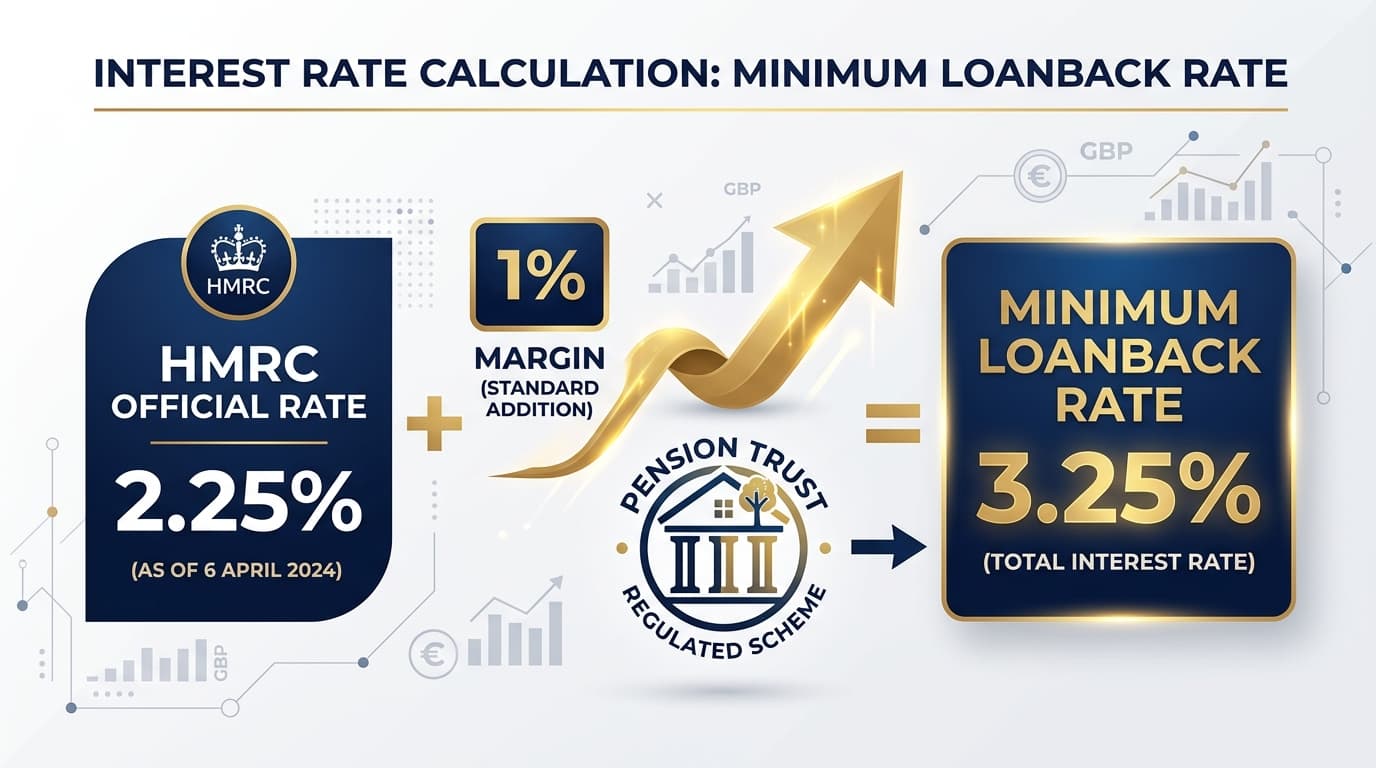
HMRC requires that SSAS loanback repayments are made in equal instalments across the loan term. This is one of the six core conditions for a permitted loanback, alongside the 50% cap, the minimum interest rate, the five-year term, the security requirement, and the restriction to the sponsoring employer.
Equal instalments means equal capital repayments — not equal total payments. Because interest accrues on the reducing balance, the total payment (capital plus interest) actually decreases over time, even though the capital element remains constant.
For a complete overview of all loanback requirements, see our guide to SSAS loanback rules.
Frequency of Repayments
HMRC does not prescribe a specific repayment frequency. Common structures include:
- Monthly: The most common structure, providing regular cash flow to the scheme and allowing close monitoring of compliance
- Quarterly: Used where monthly cash flow management is administratively burdensome for the employer
- Annual: Less common but permitted; requires more careful cash flow planning by the employer to ensure the annual lump sum is available
Monthly instalments are generally recommended because they reduce the risk of a large payment being missed and provide a clear, rolling evidence trail of compliance.
Building the Repayment Schedule: Worked Example
Let's construct a full repayment schedule for a typical SSAS loanback.
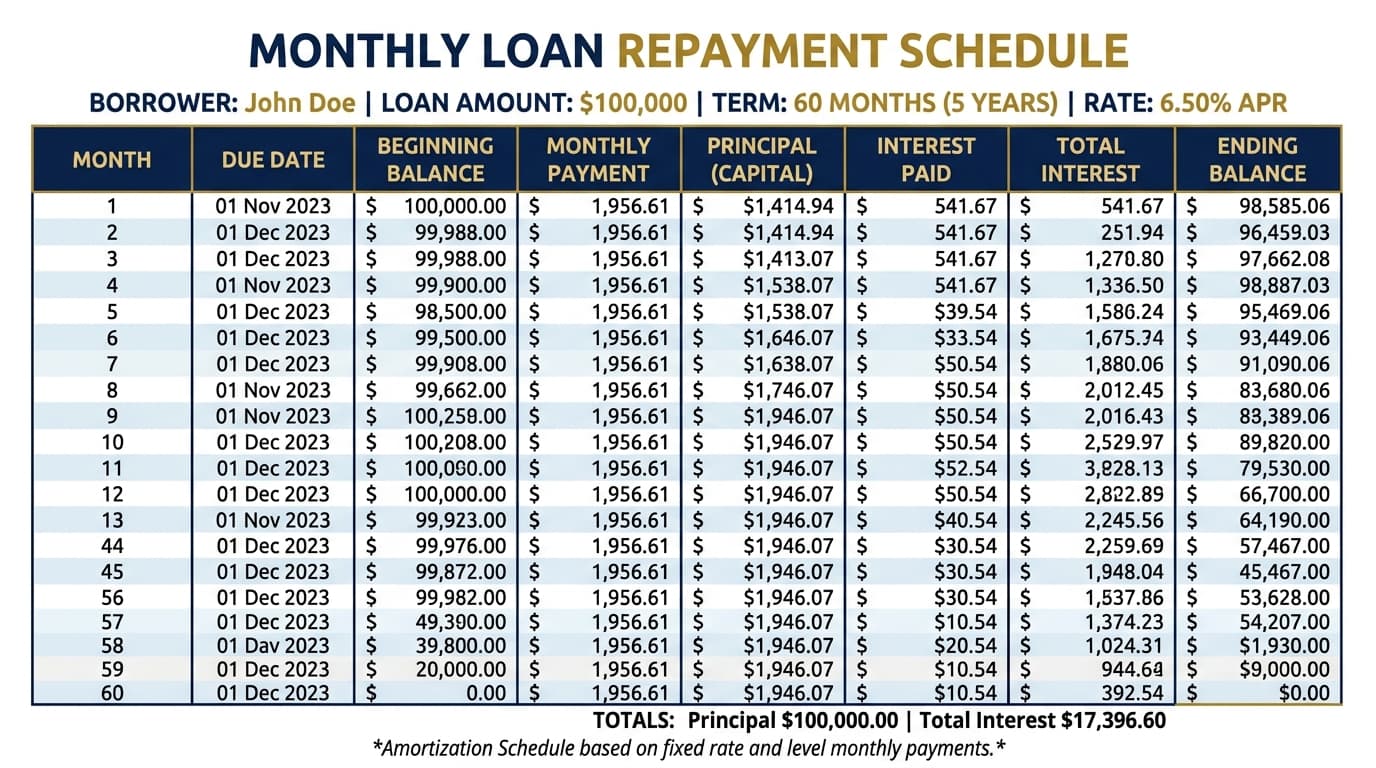
Loan details: £180,000 loanback over 5 years at 3.25% per annum, monthly repayments
Monthly capital repayment: £180,000 ÷ 60 months = £3,000 per month
Monthly interest (Year 1, Month 1): £180,000 × (3.25% ÷ 12) = £487.50
Total first payment: £3,000 + £487.50 = £3,487.50
Balance after Month 1: £180,000 − £3,000 = £177,000
Monthly interest (Year 1, Month 2): £177,000 × (3.25% ÷ 12) = £479.38
Total second payment: £3,000 + £479.38 = £3,479.38
And so on — the capital component stays constant at £3,000; the interest component reduces each month as the balance is paid down.
Annual Summary
- Year 1: 12 × £3,000 capital + interest on reducing balance from £180,000. Total interest approx. £5,363
- Year 2: 12 × £3,000 capital + interest on reducing balance from £144,000. Total interest approx. £4,290
- Year 3: 12 × £3,000 capital + interest on reducing balance from £108,000. Total interest approx. £3,217
- Year 4: 12 × £3,000 capital + interest on reducing balance from £72,000. Total interest approx. £2,145
- Year 5: 12 × £3,000 capital + interest on reducing balance from £36,000. Total interest approx. £1,073
- Total capital repaid: £180,000
- Total interest paid to pension scheme: approximately £16,088
For a complete worked example including tax calculations and scheme impact analysis, see our SSAS loanback worked example guide.
Annual Instalment Structure
For a £180,000 loanback over five years with annual repayments:
- Annual capital repayment: £36,000
- Year 1 interest: £180,000 × 3.25% = £5,850. Total payment: £41,850
- Year 2 interest: £144,000 × 3.25% = £4,680. Total payment: £40,680
- Year 3 interest: £108,000 × 3.25% = £3,510. Total payment: £39,510
- Year 4 interest: £72,000 × 3.25% = £2,340. Total payment: £38,340
- Year 5 interest: £36,000 × 3.25% = £1,170. Total payment: £37,170
- Total interest: £17,550
Matt Lenzie notes: "Annual repayments result in slightly higher total interest paid to the scheme compared to monthly repayments — because the balance outstanding reduces more slowly. From the scheme's perspective, this is marginally better. From the employer's perspective, it means a higher average annual cost."
Documenting the Repayment Schedule
The repayment schedule should be formally documented as an appendix to the loan agreement. It should specify:
- The loan start date and draw-down date
- The exact capital repayment amount per instalment
- The interest calculation method (reducing balance, specified rate)
- Instalment due dates (e.g., the 1st of each month)
- The final repayment date (must be within five years)
- The bank account to which payments are to be made (scheme bank account)
Both the trustees and the sponsoring employer should sign the loan agreement (including the repayment schedule appendix) before funds are drawn down.
Monitoring Compliance with the Schedule
Once the loanback is in place, ongoing monitoring is critical. Your SSAS administrator should:
- Reconcile actual payments received against the schedule on a monthly basis
- Flag any missed or short payments to the trustees immediately
- Maintain a running balance of capital outstanding
- Include the loanback receivable in the annual scheme accounts
Trustees must act promptly on any missed payment notification. Allowing arrears to accumulate without action risks the loanback being characterised as non-compliant. For a full compliance monitoring checklist, see our SSAS loanback compliance checklist.
What If the Employer Wants to Repay Early?
Early repayment is permitted and is not a compliance issue — it's better than late or missed repayment. If the employer repays in full before the end of the five-year term, the trustees should:
- Issue a formal receipt confirming full repayment
- Release the security charge
- Update the scheme accounts to reflect the repayment
- Consider whether a new loanback is appropriate if the business still has a funding need
Key Takeaways
- Equal instalments means equal capital repayments — the interest element reduces as the balance falls
- Monthly, quarterly, or annual frequencies are all permitted — monthly is most common and recommended
- The full repayment schedule should be documented as an appendix to the loan agreement
- Your SSAS administrator should monitor compliance with the schedule on an ongoing basis
- Missed payments must be addressed immediately to avoid compliance risk
Get Your Repayment Schedule Right
A well-documented, properly monitored repayment schedule is the foundation of a compliant SSAS loanback. Our team can help you structure and document the arrangement correctly from day one.
Contact us today for expert guidance, or read our full SSAS loanback rules guide for a complete picture.
About the Author
Matt Lenzie
Former Banker & Corporate Finance Partner
Matt Lenzie is a former banker and corporate finance partner with extensive experience in pension-backed property transactions. He founded SSAS Property Finance to help company directors and trustees navigate the complexities of commercial property acquisition through Small Self-Administered Schemes.