SSAS Capital Gains Tax Exemption: Protecting Property Profits Inside Your Pension
Written by Matt Lenzie
Former Banker & Corporate Finance Partner
SSAS Capital Gains Tax Exemption: How It Works
Capital gains tax (CGT) is one of the most significant costs facing UK property investors. At rates of up to 28% for higher-rate taxpayers on residential property gains (or 24% following recent changes), CGT can substantially erode investment returns. For commercial property investors, the CGT rate on gains is 20% for higher-rate taxpayers.
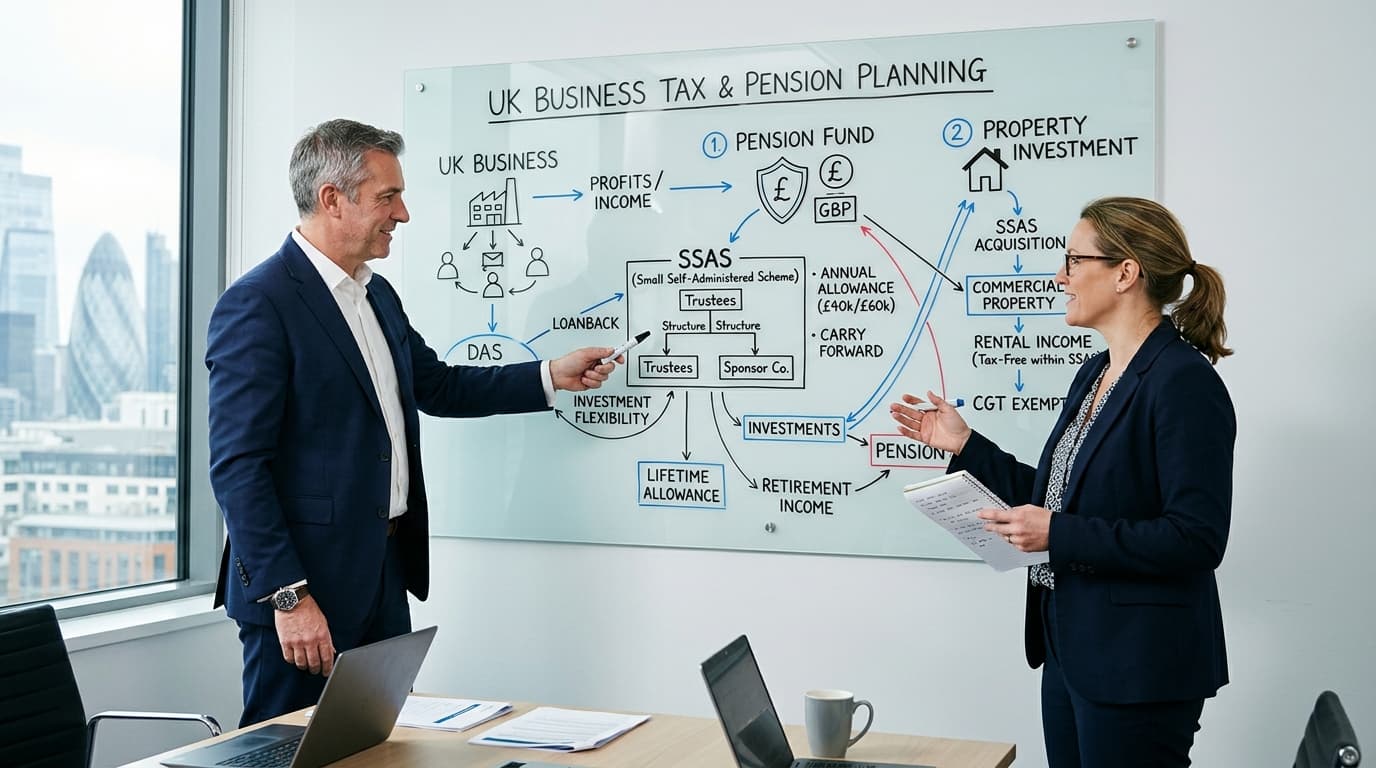
However, when commercial property is held inside a Small Self-Administered Scheme (SSAS) pension, this tax simply does not apply. The SSAS is an approved pension scheme under HMRC rules, and as such it benefits from a complete exemption from capital gains tax on the disposal of assets held within the fund.
In our experience, this is often the "second aha moment" for clients — the first being the tax-free rental income. The combination of income tax exemption on rents and CGT exemption on gains makes SSAS property investment uniquely efficient compared to any alternative structure.
The Scale of the CGT Advantage
To appreciate the significance of the CGT exemption, consider what it means in practice. A commercial property purchased for £500,000 and sold ten years later for £800,000 generates a capital gain of £300,000.
Outside a pension, a 40% taxpayer would face a CGT bill of £60,000 (at 20% on the gain), leaving net proceeds of £740,000. Inside a SSAS, the full £800,000 remains within the pension fund, available for reinvestment or eventual benefit drawdown. The £60,000 difference continues to compound within the scheme.
Matt Lenzie notes: "For clients with longer investment horizons — say, 15 or 20 years before they plan to draw pension benefits — the compounding effect of retaining the full capital gain within the fund is transformative. We have modelled scenarios where the CGT exemption alone accounts for hundreds of thousands of pounds of additional fund value at retirement."
HMRC Requirements for CGT Exemption
The CGT exemption is not automatic for every pension scheme arrangement. To qualify, the SSAS must meet HMRC's requirements for a registered pension scheme and the property transaction must be conducted in accordance with pension scheme rules.
Key requirements include:
- The SSAS must be a registered pension scheme with HMRC
- The property must be commercial (not residential) in nature
- The property must be a genuine investment asset of the scheme
- Any disposal must be at market value — transactions at below-market value to connected parties could constitute an unauthorised payment
- The proceeds of sale must remain within the pension scheme
- The disposal must not constitute trading activity (schemes that buy and sell property frequently may be treated as trading rather than investing)
The distinction between investment and trading is important. HMRC does not define an explicit number of transactions that tips a scheme into trading status, but the frequency of buying and selling, the intention at purchase, and the nature of improvements made to properties are all relevant factors.
Stamp Duty Land Tax: A Separate Consideration
It is important to distinguish the CGT exemption from stamp duty land tax (SDLT). When a SSAS purchases commercial property, SDLT is payable in the normal way — there is no exemption simply because the buyer is a pension scheme. However, the SDLT rates for commercial property are generally lower than for residential property, and for smaller commercial purchases the SDLT burden may be modest.
When property is sold from a SSAS, SDLT is payable by the buyer, not the seller — so the CGT exemption and the absence of SDLT liability on disposal make selling from a SSAS particularly efficient.
Interaction with SSAS Borrowing
Many SSAS schemes use SSAS mortgage finance to fund commercial property acquisitions, typically borrowing up to 50% of the scheme's net asset value. When a leveraged SSAS property is sold at a profit, the CGT exemption applies to the full gain — not just the gain attributable to the equity portion.
This means that leverage amplifies the benefit of the CGT exemption. If a scheme borrows £250,000 alongside £250,000 of its own funds to buy a £500,000 property, and the property later sells for £750,000, the full £250,000 gain is sheltered from CGT. Outside a pension, only the gain on the equity portion would be exempt (and even then, CGT would apply on the full gain).
Use our SSAS mortgage calculator to model the impact of leverage on potential returns.
Reinvestment of Gains Within the SSAS
One of the most powerful applications of the CGT exemption is the ability to reinvest the full proceeds of a property sale — without any tax leakage — into a new property investment. This creates a compounding effect where each successive investment benefits from the accumulated tax savings of previous disposals.
"We work with clients who have held two or three commercial properties inside their SSAS over a 15-year period. By the time they're planning their retirement income, the fund value significantly exceeds what they would have accumulated through any other structure, primarily because they've never lost a pound to CGT along the way." — Matt Lenzie
This reinvestment advantage is particularly relevant for clients who are active property investors — those who might sell one property to upgrade to a larger one, or to diversify into different property types. The SSAS structure allows this kind of active portfolio management without tax friction at each transaction.
CGT on Eventual Benefit Drawdown
A common question is whether CGT is eventually payable when pension benefits are drawn. The answer is no — CGT is not payable on pension benefit drawdown. Instead, pension income is subject to income tax in the normal way, with 25% of the fund typically available as a tax-free lump sum.
This means that the CGT exemption is permanent for gains made within the SSAS, not merely a deferral. The gains are never subject to CGT at any point, although the eventual pension income drawn will be subject to income tax (other than the tax-free lump sum element).
Property Development and CGT Exemption
Some SSAS trustees consider undertaking development or refurbishment of their commercial property to enhance its value. This is permissible in principle, but HMRC applies heightened scrutiny to development activity within pension schemes.
Key considerations include:
- Development activity must be investment-oriented, not trading-oriented
- The SSAS must not pay connected parties for development work at above-market rates
- Any value-enhancing works must be funded from scheme resources or permitted borrowing
- HMRC may challenge whether a development gain qualifies for the investment exemption if the scheme's primary intention was to develop and sell
For guidance on development land and SSAS, see our article on SSAS development land investment.
Practical Steps to Preserve the CGT Exemption
To ensure that a SSAS property sale qualifies for the CGT exemption, trustees should:
- Obtain an independent market valuation before any connected party disposal
- Ensure the SSAS scheme administrator prepares proper accounts recording the disposal
- Report the disposal correctly on the SSAS annual return to HMRC
- Keep the sale proceeds within the pension fund — do not transfer to members without proper benefit authorisation
- Take professional advice if the transaction is complex or involves connected parties
Key Takeaways
- SSAS pension schemes are completely exempt from capital gains tax on commercial property disposals
- This exemption applies to the full gain, including any leveraged portion
- The exemption is permanent, not a deferral — gains are never subject to CGT at any stage
- Proceeds must remain in the pension scheme and property must be commercial
- Frequent buying and selling may cause HMRC to treat activity as trading rather than investment
- Development activity requires careful management to preserve investment (rather than trading) status
Start Planning Your Tax-Efficient SSAS Property Strategy
The combination of tax-free rental income and complete CGT exemption makes SSAS property investment one of the most tax-efficient strategies available to UK business owners and company directors. However, the rules are complex and the consequences of getting it wrong can be severe.
Our team of specialists can help you structure a SSAS property strategy that captures the maximum tax advantage while maintaining full HMRC compliance. Contact us today to arrange a confidential discussion.
Also see our guides on SSAS tax-free rental income, employer contribution tax relief, and comprehensive SSAS tax planning strategies.
About the Author
Matt Lenzie
Former Banker & Corporate Finance Partner
Matt Lenzie is a former banker and corporate finance partner with extensive experience in pension-backed property transactions. He founded SSAS Property Finance to help company directors and trustees navigate the complexities of commercial property acquisition through Small Self-Administered Schemes.